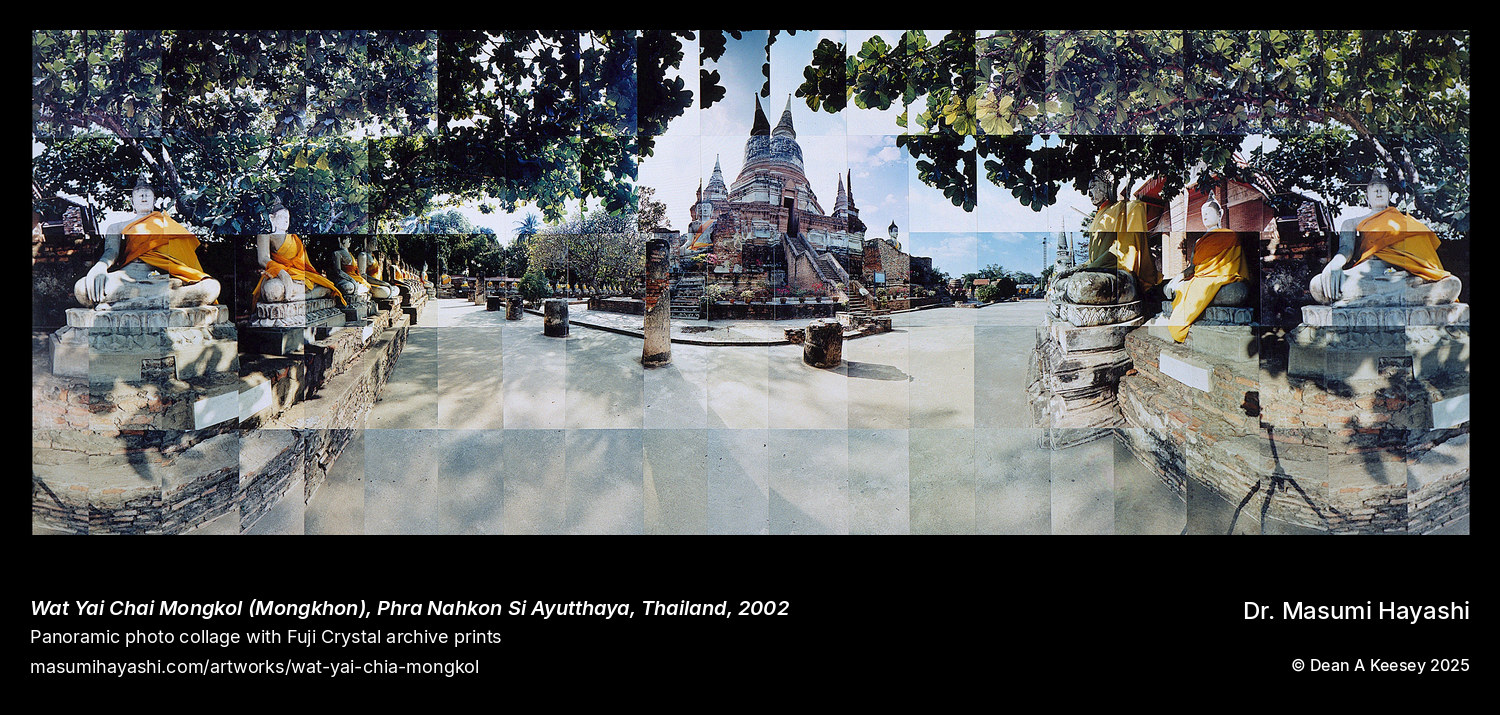
Wat Yai Chaya Mongkol (Mongkhon)
Ayutthaya, n/a, Thailand
Panoramic photo collage with Fuji Crystal archive prints
2002
27 x 73
This monumental 27-by-73-inch vertical panorama documents Wat Yai Chai Mongkhon—the “Great Monastery of Auspicious Victory” in Ayutthaya, Thailand’s ancient capital destroyed by Burmese invasion in 1767. The over-six-foot height captures the massive central chedi (stupa) whose construction in 1592 celebrated King Naresuan’s victory over the Burmese crown prince in single combat on elephant-back, establishing Thai independence and heroic national narrative.
Created in 2002, the work represents the only Thai site in the Sacred Architectures series, expanding documentation beyond the Indian subcontinent and Cambodian Angkor to encompass mainland Southeast Asian Buddhist traditions. Ayutthaya’s UNESCO World Heritage ruins preserve four centuries of Thai royal architecture before Burmese armies destroyed the city, forcing capital relocation to Bangkok and leaving temples to atmospheric decay.
The extreme vertical format captures the chedi’s soaring proportions—a 62-meter tower rising from lotus-bud base through graduated tiers toward pointed finial, the conical mass dominating the monastery complex. Surrounding the main chedi, orderly rows of smaller Buddha images in meditation pose create devotional landscape where pilgrims walk among serene stone figures.
King Naresuan’s 1592 victory freed Thailand from Burmese vassalage, the duel on elephant-back becoming foundational national legend. The commemorative chedi’s scale reflects the victory’s significance—a monument visible across Ayutthaya’s plains, asserting Thai sovereignty through architectural height. The monastery remains active, orange-robed monks residing among historical ruins, maintaining worship traditions continuous since the fourteenth century.
The vertical format suits Thai chedi architecture’s characteristic emphasis on upward thrust—unlike the horizontal spread of Indian temple compounds or the concentrated mass of Khmer temples, Thai stupas emphasize pointed elevation, their vertical profiles dominating sacred geography. The six-foot-plus height replicates the devotional experience of gazing upward at architecture designed to direct attention toward transcendence.