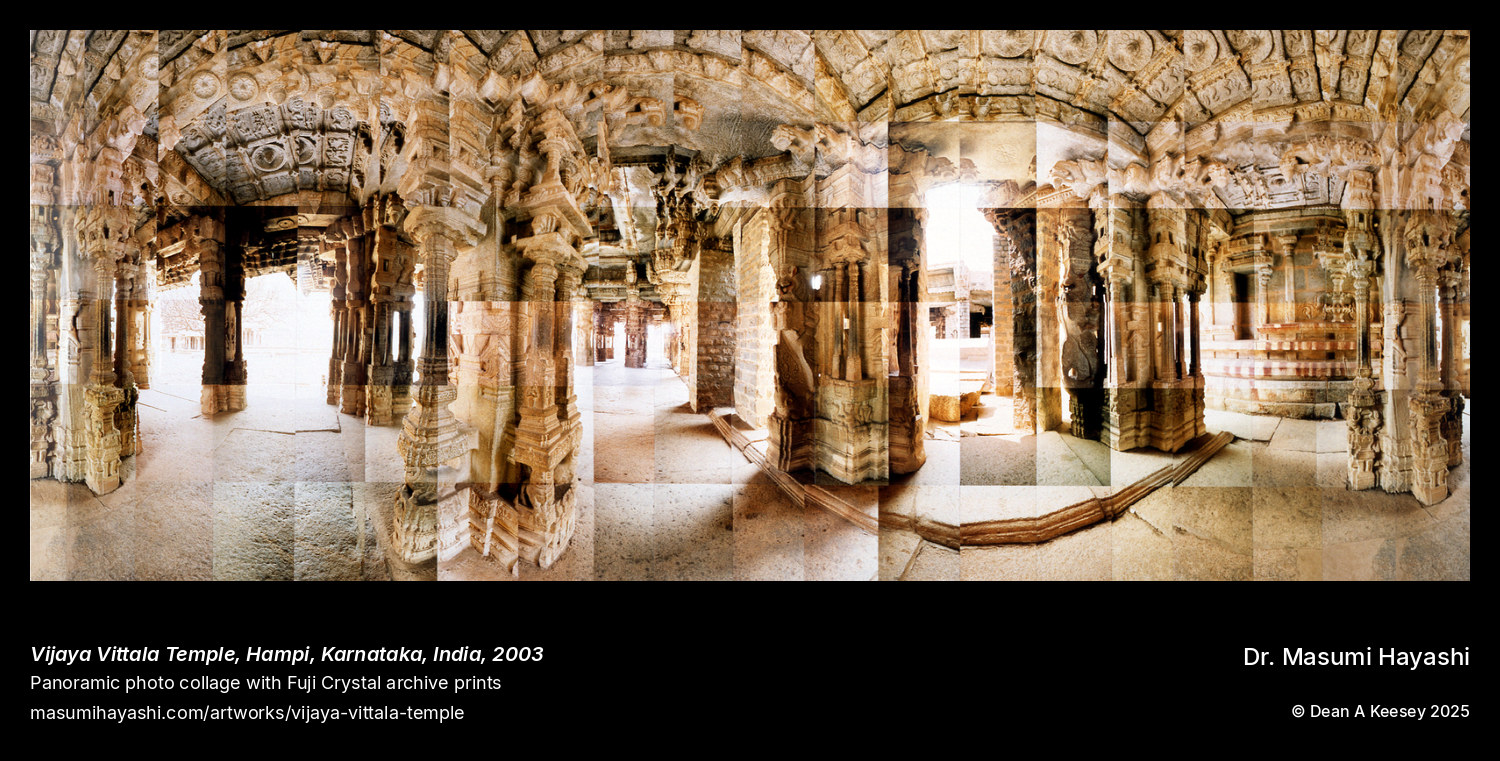
Vijaya Vittala Temple
Hampi, Karnataka, India
Panoramic photo collage with Fuji Crystal archive prints
2003
70 x 28
This monumental 70-by-28-inch horizontal panorama documents the Vijaya Vittala Temple—the crown jewel of Hampi’s UNESCO World Heritage Site where the Vijayanagara Empire invested extraordinary resources creating architectural masterpiece honoring Vishnu in his Vittala incarnation. The nearly six-foot width captures the temple complex’s extraordinary features: the iconic stone chariot housing Garuda (Vishnu’s eagle mount), musical pillars producing distinct notes when struck, and elaborate mandapa (pillared halls) demonstrating South Indian temple architecture’s most sophisticated expression.
Created in 2003, the work represents Hayashi’s first visit to Hampi, establishing engagement with the ruined capital she would revisit in 2004 for additional documentation. The Vijaya Vittala Temple, never fully completed despite decades of construction, remains the most ambitious architectural project undertaken by Vijayanagara rulers—a temple so magnificent that local legend claims its construction bankrupted the empire.
The stone chariot, perhaps South India’s most photographed monument, demonstrates Vijayanagara sculptors’ virtuosity—wheels that once rotated on axles, carved from single granite blocks creating functional sculpture. This engineering achievement represents Dravidian temple architecture’s playful elaboration, the practical form of processional chariot rendered permanent in stone.
The musical pillars constitute another engineering marvel: hollow carved columns producing distinct musical notes when struck, each pillar tuned through careful calculation of wall thickness and cavity resonance. Temple musicians could perform ragas using architectural elements as instruments, the building itself becoming sound-producing body.
The extreme horizontal format suits Vijaya Vittala’s lateral spread—unlike vertically-oriented North Indian shikhara temples, South Indian Dravidian architecture emphasizes horizontal extension through multiple mandapas, corridors, and subsidiary shrines arranged along axes. The panorama captures this organizational logic, the viewer’s eye traveling through successive architectural zones toward the sanctum housing the deity.
The temple’s incomplete state—construction halted when the empire fell to Deccan sultanates in 1565—preserves evidence of construction techniques: unfinished carvings, rough-cut stone awaiting sculptors, and abandoned blocks documenting medieval building practices.