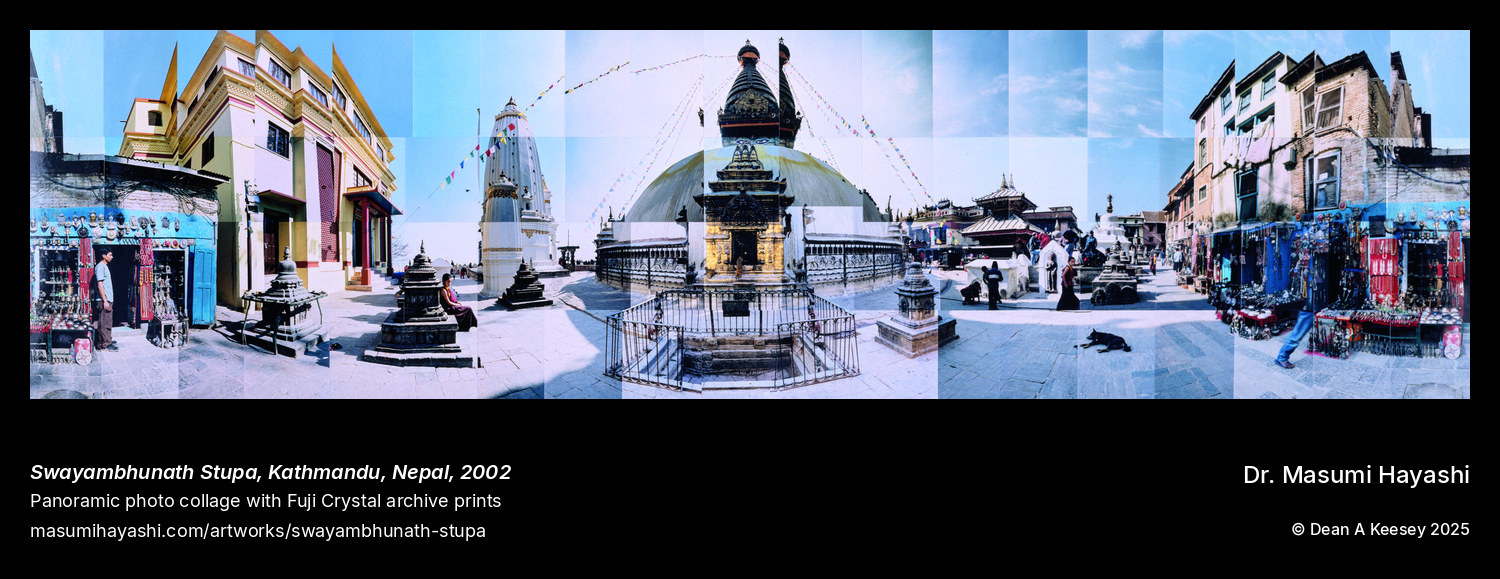
Swayambhunath Stupa
Kathmandu, n/a, Nepal
Panoramic photo collage with Fuji Crystal archive prints
2002
67 x 19
This monumental 67-by-19-inch horizontal panorama documents Swayambhunath Stupa—the “Self-Created” shrine atop a forested hill west of Kathmandu where a lotus spontaneously appeared from the primordial lake filling the Kathmandu Valley, marking the spot where ancient worship established one of Asia’s most important pilgrimage sites. The nearly six-foot width captures the hilltop complex where the great white stupa’s eyes gaze across the valley surrounded by smaller shrines, prayer wheels, and constantly circling devotees.
Created in 2002, the work documents one of Nepal’s most recognizable landmarks—the white dome surmounted by golden spire, painted eyes gazing in the four cardinal directions representing the Buddha’s all-seeing wisdom. Known as the “Monkey Temple” for the sacred simians inhabiting its forested slopes, Swayambhunath attracts both Buddhist and Hindu worshippers reflecting the Kathmandu Valley’s characteristic religious syncretism.
The horizontal format emphasizes the hilltop’s panoramic situation—365 steps ascending from valley floor to summit, the stupa commanding views across Kathmandu while itself visible from throughout the city. The format captures the complex’s lateral extent: main stupa flanked by smaller shrines, Tibetan monasteries, Hindu temples to Harati (protector of children), and perpetual circumambulation by devotees walking clockwise around the sacred structure.
Legend dates the stupa to the fifth century BCE, though historical construction began during the Licchavi period (fifth century CE). The site’s antiquity predates Buddhist presence in Nepal, the primordial lotus origin myth suggesting prehistoric sacred geography later absorbed into Buddhist tradition. Each major earthquake—most recently the devastating 2015 Gorkha earthquake—has damaged and rebuilt the stupa, the current structure layering restorations across centuries.
The work documents pre-earthquake architecture that subsequent disaster damaged, acquiring archival significance beyond artistic achievement.