Royal Bhutan Temple, Bodh Gaya, Bihar, India
Bodh Gaya, Bihar, India
Panoramic Photo Collage
2000
27 x 50
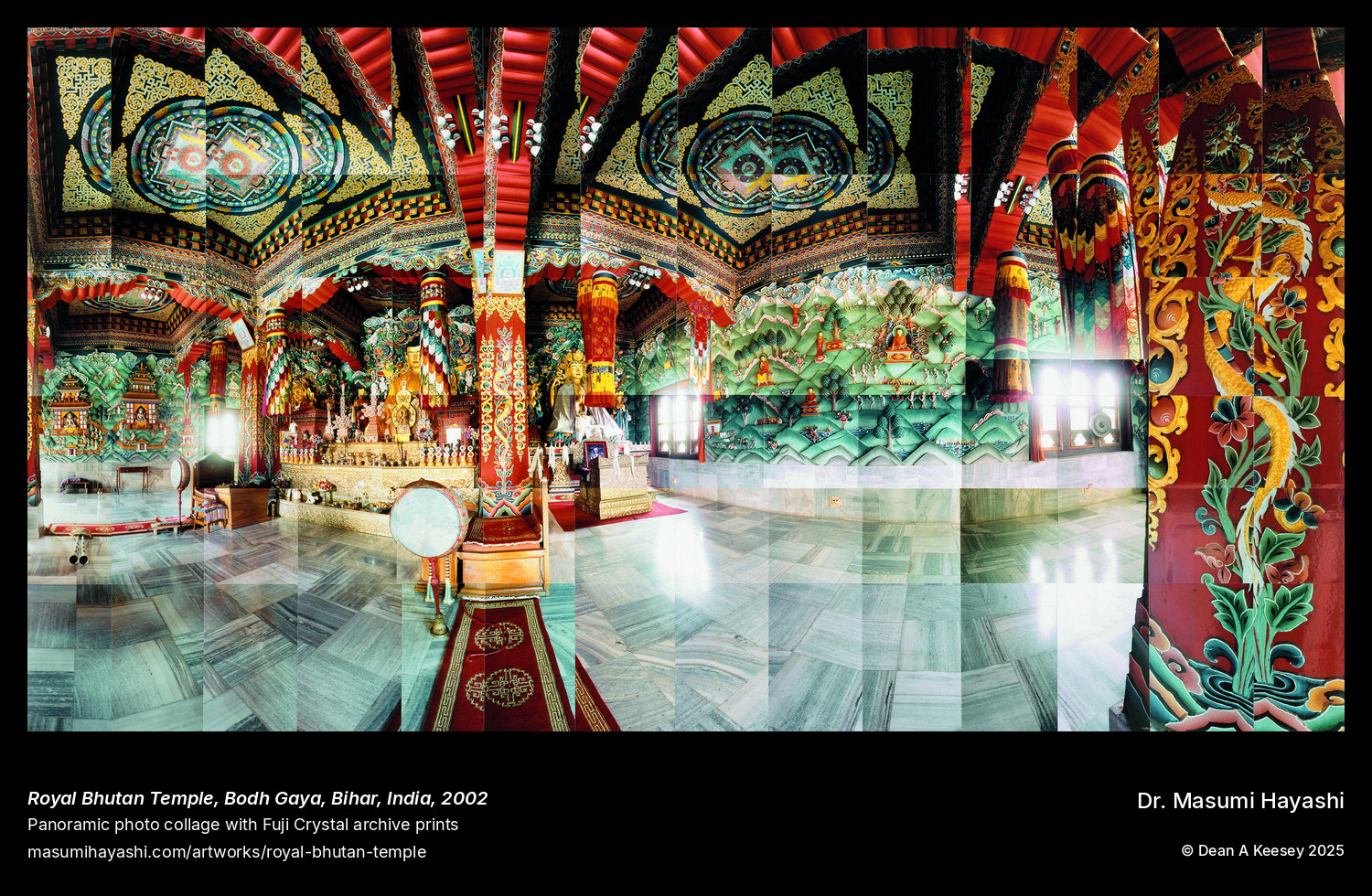
This vertical 27-by-50-inch panorama documents the Royal Bhutan Temple at Bodh Gaya—one of numerous national temples constructed by Buddhist countries surrounding the Mahabodhi Temple where Siddhartha Gautama achieved enlightenment. The four-foot-plus height captures the temple’s Bhutanese architectural distinctiveness: sloped whitewashed walls, ornate wooden windows, and traditional Himalayan Buddhist design transplanted to the plains of Bihar.
Created in 2000 alongside documentation of the Bodhi Tree itself, the work expands Bodh Gaya coverage beyond the central Mahabodhi Temple to encompass the international Buddhist precinct that has developed around Buddhism’s holiest site. Beginning in the nineteenth century, Buddhist nations constructed temples representing their distinctive architectural traditions—Thai, Sri Lankan, Japanese, Tibetan, and Bhutanese temples creating an architectural anthology of global Buddhism within walking distance of the enlightenment site.
Bhutan’s Kingdom maintains perhaps the purest preservation of Vajrayana (Tibetan) Buddhism, its isolated Himalayan valleys protecting religious institutions from the destruction that devastated Tibetan monasteries following Chinese occupation. The Royal Bhutan Temple represents this living tradition transplanted to Buddhism’s birthplace—Bhutanese monks maintaining worship traditions continuous since Guru Rinpoche introduced Buddhism to Bhutan in the eighth century.
The vertical format suits Bhutanese architecture’s characteristic proportions: buildings appearing to rise massively from ground level, whitewashed walls tapering slightly inward, elaborate wooden details concentrated at window and roof levels. Unlike the horizontal sweep of Indian temple compounds, Bhutanese sacred architecture emphasizes vertical mass and solidity, fortress-monasteries reflecting their Himalayan origin where sacred and defensive architecture merged.
The work documents contemporary Buddhist devotion rather than archaeological heritage—a functioning temple where Bhutanese pilgrims worship at the very site where Buddhism originated, connecting twenty-first-century practice to twenty-five centuries of tradition.