Preah Khan Temple, Angkor, Siem Reap, Cambodia
Angkor, Siem Reap, Cambodia
Panoramic Photo Collage
2000
26 x 67
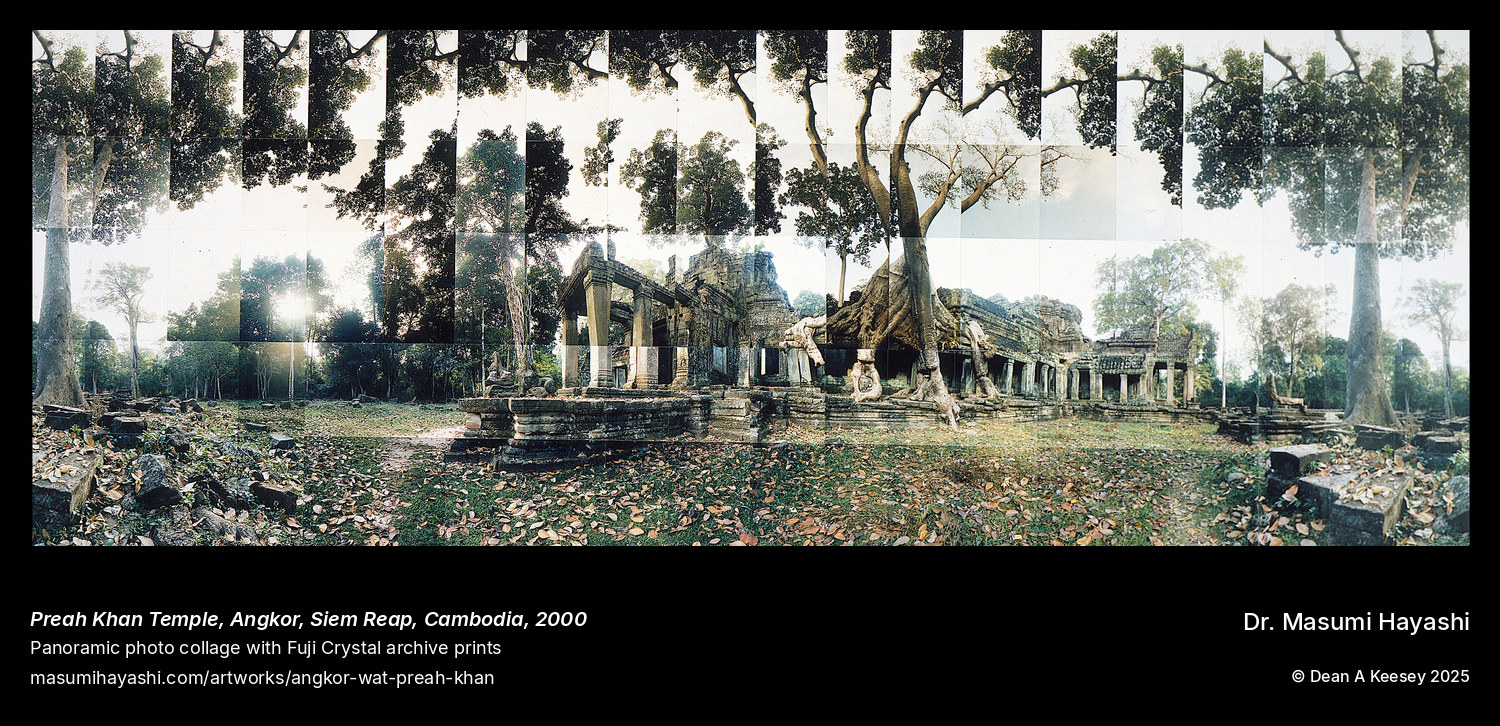
This monumental 26-by-67-inch horizontal panorama documents Preah Khan—the “Sacred Sword” temple built by Jayavarman VII as one of the largest Angkor-era complexes, serving as temporary capital, monastery, and Buddhist university housing over 97,000 attendants according to contemporary inscriptions. The over-five-foot width captures the temple’s extraordinary lateral extent, galleries stretching through jungle toward distant towers.
Created in 2000 during Hayashi’s pivotal Cambodian journey, the work represents her engagement with Angkor’s “unreconstructed” temples—monuments left in jungle’s embrace where strangler figs wrap galleries and tree roots lift paving stones, creating the romantic ruin aesthetic that draws photographers and filmmakers to Cambodia. Unlike Angkor Wat’s manicured presentation, Preah Khan remains partially consumed by forest, deliberate conservation decision preserving the experience of nineteenth-century European “discovery.”
King Jayavarman VII built Preah Khan in 1191 CE to honor his father, dedicating the temple to Buddhism while incorporating Hindu and animist elements reflecting Khmer religious syncretism. The complex functioned as Buddhist university with 1,000 teachers and perhaps 100,000 support staff—a city-scale institution whose collapsed buildings hint at former grandeur.
The horizontal format suits Preah Khan’s organizational logic: unlike tower-focused temples emphasizing vertical aspiration, Preah Khan extends horizontally through multiple concentric enclosures, its galleries leading through progressive thresholds toward the central sanctuary. The panorama captures this spatial experience—the viewer’s eye traveling through successive architectural zones, corridor perspectives suggesting labyrinthine depth.
The jungle’s partial reclamation creates temporal meditation: architecture built to endure eternally succumbing to organic time, the Khmer Empire’s fall allowing forest to reclaim monuments within decades. Preah Khan documents this process—stones still standing but forest advancing, the architectural body being slowly consumed by vegetable life, a memento mori in monumental scale.