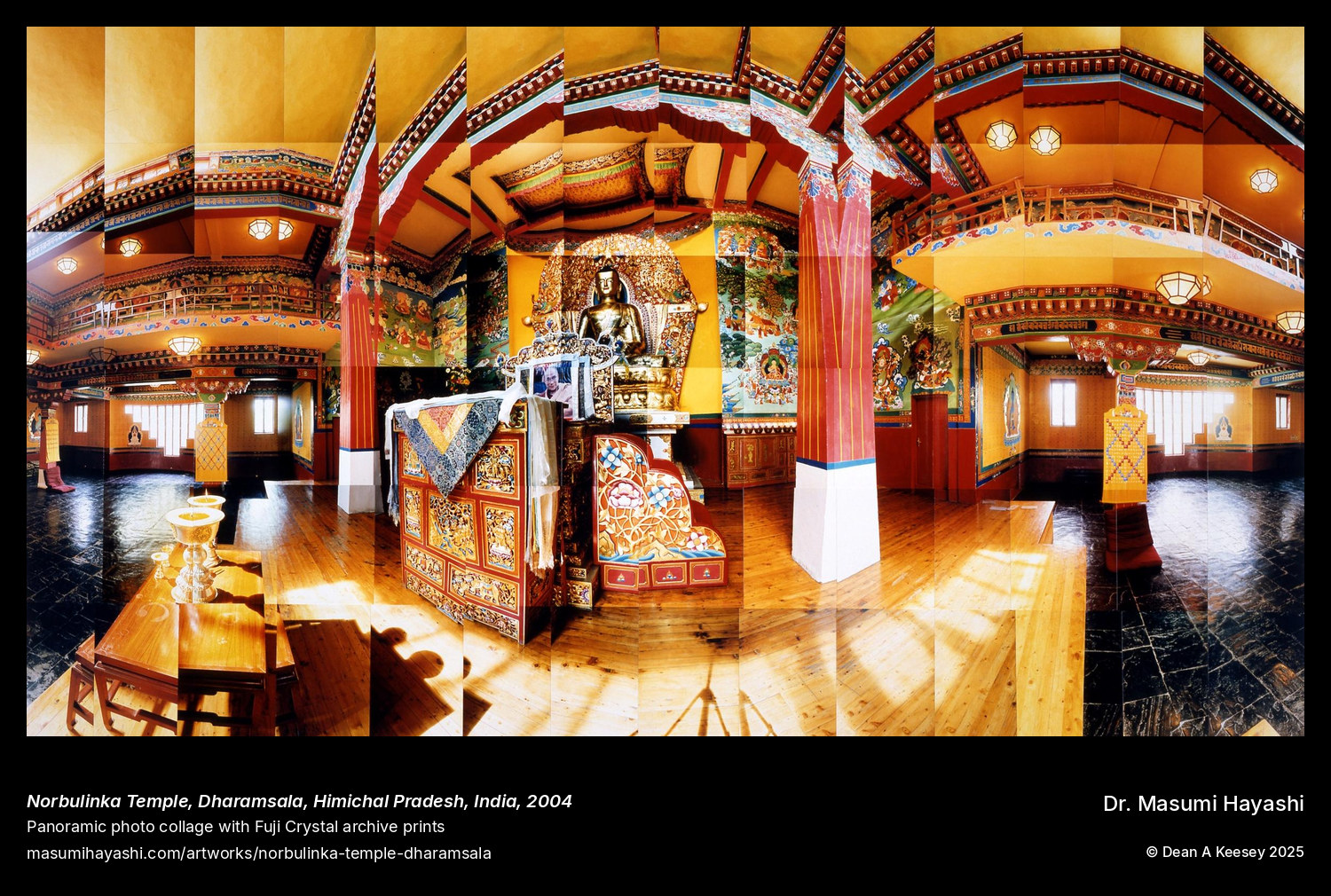
Norbulinka Temple, Dharamsala, Himichal Pradesh, India
Dharamsala, Himichal Pradesh, India
Panoramic Photo Collage
2004
49" x 28"
This 49-by-28-inch horizontal panorama documents the Norbulingka Institute in Dharamsala, Himachal Pradesh—a cultural preservation center established in 1995 to safeguard Tibetan traditional arts threatened by the Cultural Revolution’s systematic destruction in Chinese-occupied Tibet. Named after Norbulingka Palace, the Dalai Lama’s summer residence in Lhasa built in 1755, the institute symbolically recreates exiled Tibetan civilization’s artistic heritage in the Indian Himalayas forty-five years after the 1959 exodus.
Between 1966 and 1976, China’s Cultural Revolution destroyed over six thousand Tibetan monasteries, burned Buddhist scriptures, melted statues for metal, and killed or imprisoned master artisans whose knowledge of thangka painting, metal casting, woodcarving, and manuscript illumination nearly vanished. The Norbulingka Institute addresses this catastrophic cultural loss by training young Tibetan refugees in traditional techniques, employing master artisans who learned their crafts in pre-1959 Tibet to teach apprentices before their knowledge dies with them.
Unlike Tsuglagkhang Temple’s political and religious authority—the Dalai Lama’s residence and government-in-exile headquarters—Norbulingka focuses exclusively on cultural transmission through hands-on artistic education. The campus includes temple complexes with Japanese architectural influences reflecting major donors, workshops where visitors observe artisans hand-painting thangkas and hammering bronze statues using identical techniques employed in pre-occupation Tibet, and gardens recreating Tibetan landscaping traditions.
Created in 2004, the work documents an institution existing as direct response to occupation and diaspora—Tibetan culture preserved not in its homeland but in exile communities maintaining traditions the Chinese government continues suppressing. The horizontal format suggests documentation of multiple buildings spread across landscaped grounds or workshop interiors showing artisan stations demonstrating different traditional crafts, emphasizing the institute’s spatial extent and programmatic diversity rather than single monumental structure. The work captures heritage preservation as active practice requiring institutional infrastructure, economic support, and intergenerational transmission when homeland systematically erases what exile communities struggle to maintain.