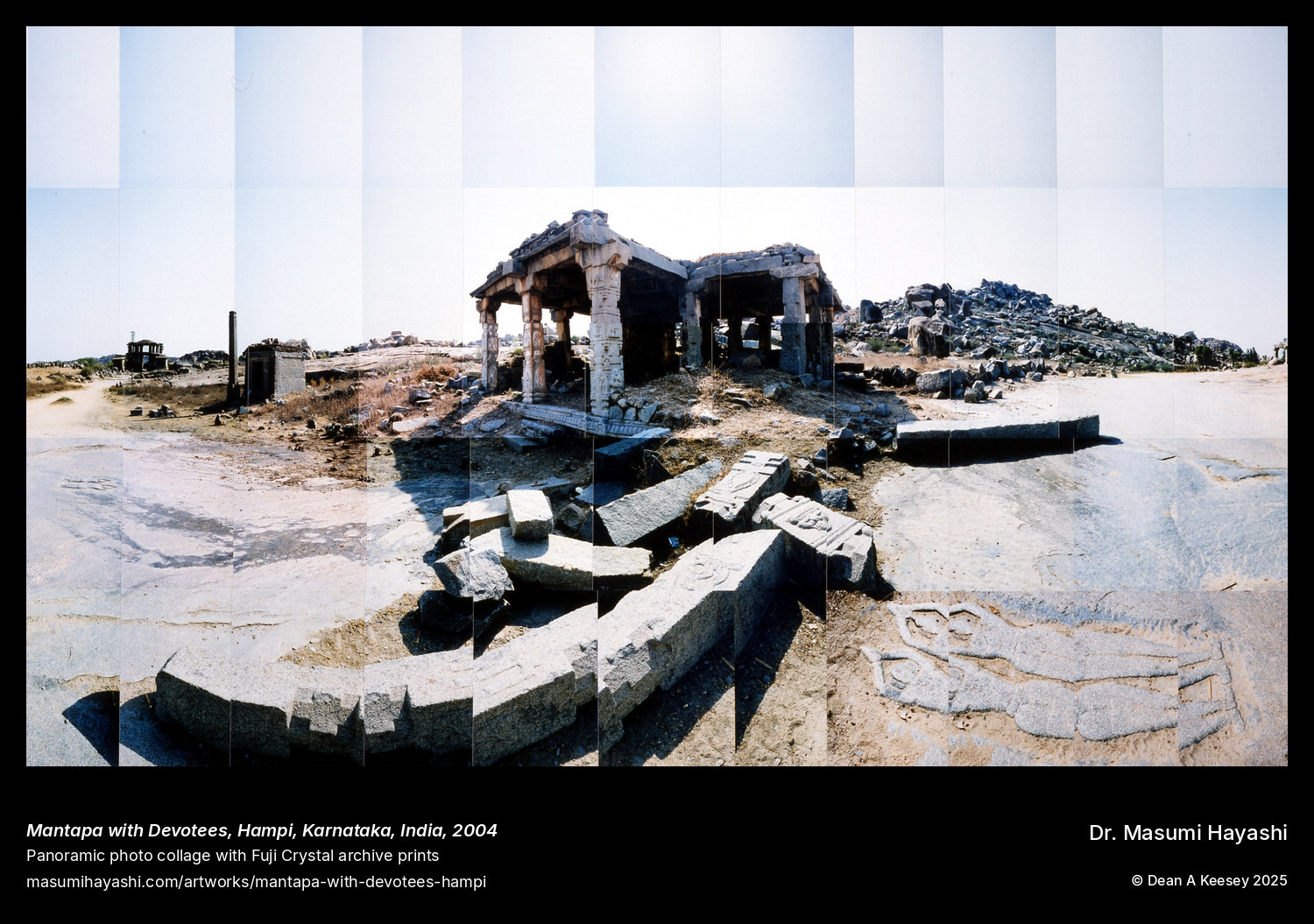
Mantapa with Devotees, Hampi, Karnataka, India
Hampi, Karnataka, India
Panoramic Photo Collage
2004
22" x 37"
This 22-by-37-inch vertical panorama documents a mantapa—pillared pavilion—at Hampi, the UNESCO World Heritage Site preserving ruins of the Vijayanagara Empire’s fourteenth-to-sixteenth-century capital. The title’s inclusion of “with Devotees” signals living sacred landscape rather than archaeological ruin, pilgrims or worshippers activating ancient architectural space through continued religious practice despite centuries of abandonment following the catastrophic 1565 Battle of Talikota when coalition forces sacked the capital.
Mantapas represent essential Hindu temple elements: open or semi-enclosed pillared halls preceding main shrines, serving as gathering spaces for devotees, venues for ceremonies, and transitional zones between exterior worldly realm and interior sanctums housing deity images. Vijayanagara architects achieved distinctive mantapa design through massive monolithic granite pillars carved with extraordinary detail—deities, mythological narratives, floral motifs creating vertical sculptural programs crowned by elaborate capitals supporting corbelled roof structures.
The vertical format captures mantapa architecture’s characteristic tall carved pillars supporting elevated roofs, the aspect ratio emphasizing spatial relationships between ground plane and covering structure. Unlike the 2003 Hemakuta Hill panorama documenting scattered temple clusters across elevated terrain through extreme horizontal sweep, this 2004 work focuses on individual architectural elements and human-scale devotional spaces, demonstrating systematic multi-year coverage understanding Hampi’s complexity.
Created in 2004, the work represents Hayashi’s return to Hampi following the previous year’s hilltop vista documentation. The two works together capture architectural diversity across scales—from distributed landscape to intimate pillared halls where ancient stone still shelters contemporary worship. Hampi’s temple complexes maintain ritual continuity at select sites where the Virupaksha Temple has functioned continuously since the seventh century through Vijayanagara imperial patronage to present-day village worship, devotees navigating boulder pathways connecting abandoned palace ruins and living shrines.