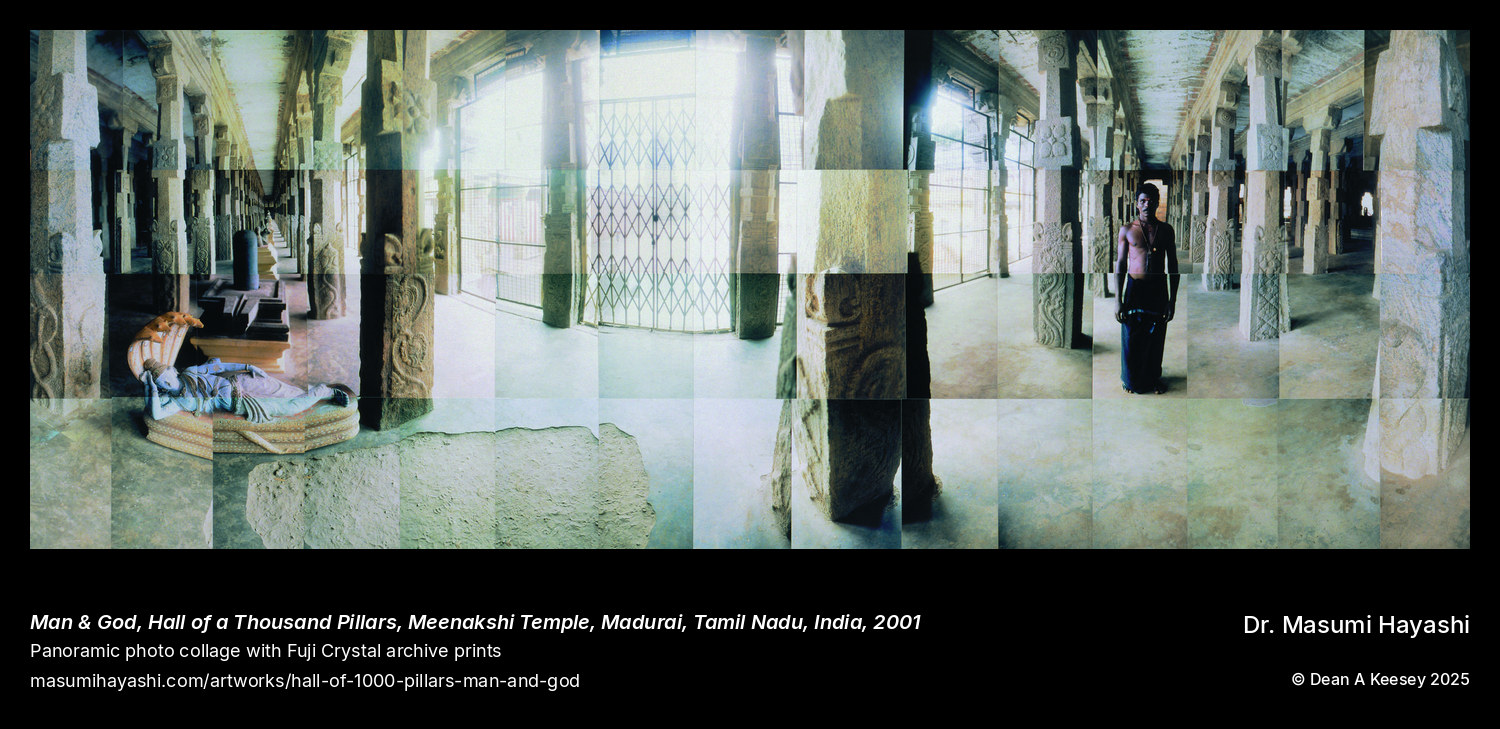
Man & God, Hall of a Thousand Pillars, Meenakshi Temple, Madurai, Tamil Nadu, India
Madurai, Tamil Nadu, India
Panoramic Photo Collage
2001
53 X 19.5
This 53-by-19.5-inch horizontal panorama documents the Aayiram Kaal Mandapam (Hall of a Thousand Pillars) at Meenakshi Temple in Madurai—one of Dravidian temple architecture’s most spectacular achievements, where 985 intricately carved granite pillars create infinite perspective effects as parallel rows converge toward vanishing points. The title “Man & God” suggests the hall’s function as threshold space where devotees encounter divine presence through architectural immersion, pilgrims dwarfed by forests of pillars designed to evoke cosmic order and divine infinitude.
Built in 1569 CE by Ariyanatha Mudaliar during the Nayak period reconstruction, the hall measures 183 feet long by 170 feet wide, positioned on the temple complex’s northern side near the Sundareshwar shrine entrance. Though not quite one thousand, the “thousand” pillar designation signifies countless abundance—each column carved from single granite blocks featuring unique sculptural programs depicting yalis (mythical lion-creatures), deities, mythological narratives, musicians, and dancers representing the sixty-four arts. These individual carvings create unified architectural experience through multiplication and perspective, the repetitive pillar rhythms generating spatial effects impossible through conventional construction.
Meenakshi Temple, dedicated to the fish-eyed goddess Meenakshi (a Tamil form of Parvati) and her consort Sundareshwar (Shiva), unusually emphasizes goddess over male deity, reflecting Dravidian goddess-centered traditions predating northern Hindu influence. The Nayak dynasty’s sixteenth-and-seventeenth-century architectural patronage transformed Madurai into pilgrimage destination rivaling Varanasi, commissioning fourteen gopurams and expanded enclosures across a forty-five-acre complex maintaining intense ritual life.
Created in 2001 as the first of Hayashi’s three Meenakshi Temple works spanning 2001-2003, this horizontal panorama employs format suited to pillar hall documentation—the nearly-four-and-a-half-foot width capturing lateral architectural extent while the narrow height emphasizes the forest-like effect of columns extending into distance.