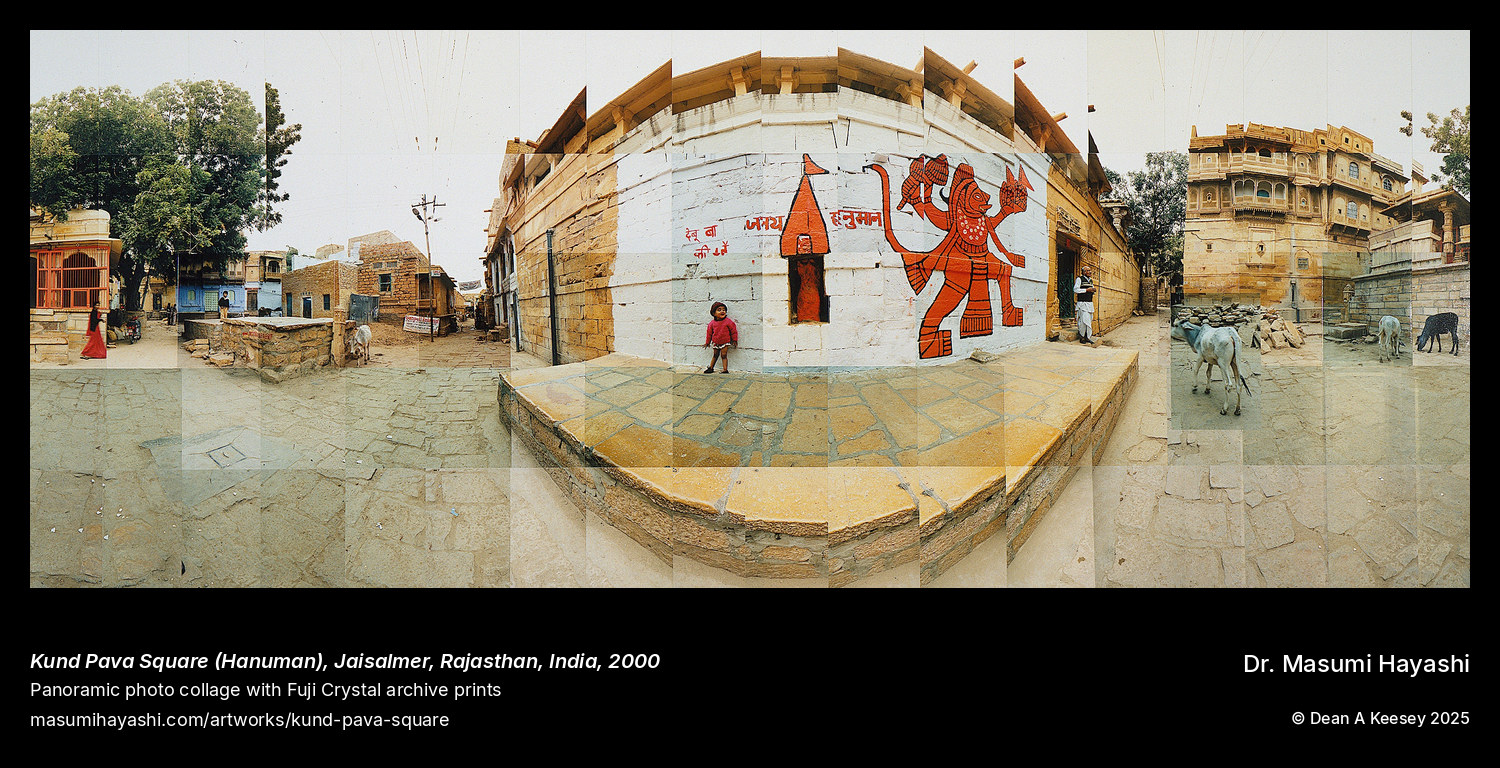
Kund Pava Square (Hanuman)
Jaisalmer, Rajasthan, India
Panoramic photo collage with Fuji Crystal archive prints
2000
35 x 73
This monumental 35-by-73-inch vertical panorama documents Kund Pava Square in Jaisalmer—a ceremonial water reservoir and gathering space within the Golden City’s medieval fortress where the monkey god Hanuman presides over sacred architecture serving both ritual and communal functions. The nearly six-foot height captures the stepped tank’s vertical descent from street level through multiple masonry terraces to the water surface below, while surrounding temple structures and merchant houses create enclosed architectural embrace.
Created in 2000 during Hayashi’s pivotal turn-of-millennium journey documenting India’s major religious traditions, the work represents her engagement with water architecture—the stepped wells, tanks, and reservoirs that constitute distinctive South Asian architectural typology where engineered infrastructure serves simultaneously as sacred space, social gathering point, and civic monument. Unlike the natural rivers sanctified through religious tradition, kunds are deliberately constructed sacred topography, human engineering dedicated to divine purposes.
The Hanuman dedication situates this square within popular Hindu devotion centered on the monkey deity—Rama’s devoted servant in the Ramayana epic, embodiment of selfless service and supernatural strength. Hanuman temples appear throughout India, often in public squares, marketplaces, and crossroads where his protective presence guards against malign influences. The kund’s association with Hanuman transforms utilitarian water storage into sacred precinct.
Jaisalmer’s location within the Thar Desert makes water precious beyond ordinary valuation. The fortress city, founded in 1156 CE by Rawal Jaisal, prospered through caravan trade between India and Central Asia until railroads and Partition redirected commerce elsewhere. The kund represents medieval water management technology—stepped architecture allowing access regardless of seasonal water levels, stone construction preventing seepage in arid climate, and architectural treatment elevating infrastructure to monument. The golden sandstone characteristic of Jaisalmer’s architecture creates warm luminosity throughout the composition, the material that gives the “Golden City” its name glowing in northwestern India’s intense sunlight.
The extreme vertical format documents the square’s spatial organization: upper levels providing gathering space for devotees and festivals, intermediate terraces enabling graduated access, lower steps reaching water for ritual bathing and collection. This vertical hierarchy carries religious meaning—descent toward water replicating purification’s spiritual logic, the physical journey downward mirroring inner cleansing sought through sacred contact with blessed waters.