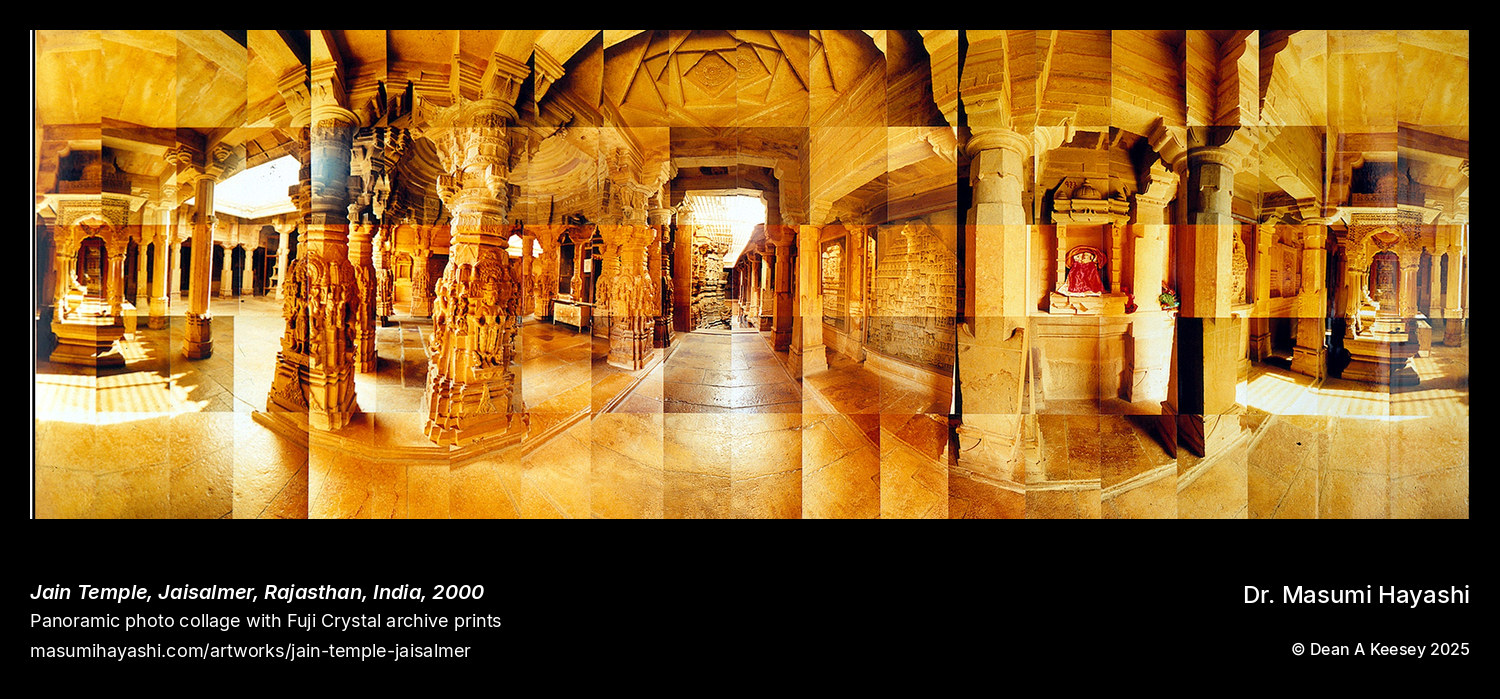
Jain Temple, Jaisalmer, Rajasthan, India
Jaisalmer, Rajasthan, India
Panoramic Photo Collage
2000
25 x 73
At 25-by-73 inches, this soaring vertical panorama stands as the tallest work in the Sacred Architectures series—over six feet of height documenting one of seven interconnected Jain temples within Jaisalmer Fort, the “Golden City” of Rajasthan’s Thar Desert. The extreme vertical format matches the shikhara towers’ upward thrust, capturing the architectural progression from ground level to elevated sanctums through multiple stories of intricate carving.
The temples were constructed between the twelfth and sixteenth centuries by Jaisalmer’s wealthy Jain merchant community, whose control of desert trade routes—camel caravans transporting silk, spices, and precious stones between India and Central Asia—generated the capital for extraordinary architectural patronage. Despite representing a religious minority within predominantly Hindu Rajput kingdoms, Jain merchants wielded disproportionate economic influence, and royal protection enabled this temple complex’s construction and elaboration across four centuries.
Yellow sandstone characterizes the fort’s exterior architecture, creating Jaisalmer’s distinctive golden appearance especially vivid at sunset. But the Jain temples’ interiors employ white marble, the cool reflective stone contrasting with exterior warmth while carrying symbolic associations with purity. Every surface bears carving—pillars, ceilings, walls, doorframes creating overwhelming visual density. The sculptural programs depict the twenty-four Tirthankaras, Jainism’s spiritual teachers shown in meditation poses with peaceful expressions. Importantly, the imagery avoids martial themes: Jainism’s core principle of ahimsa, absolute non-violence toward all living beings, prohibits violent imagery found in Hindu temples depicting cosmic battles between gods and demons.
Created in 2000 as part of Hayashi’s turn-of-millennium documentation of India’s major religious architectural traditions, this work represents the only confirmed Jain temple in the series. The vertical format enables comprehensive documentation of the multi-story spatial organization characteristic of Jain temple design, where sculptural detail distributed across height requires extreme vertical sweep to capture the tower’s full elevation from base to finial.