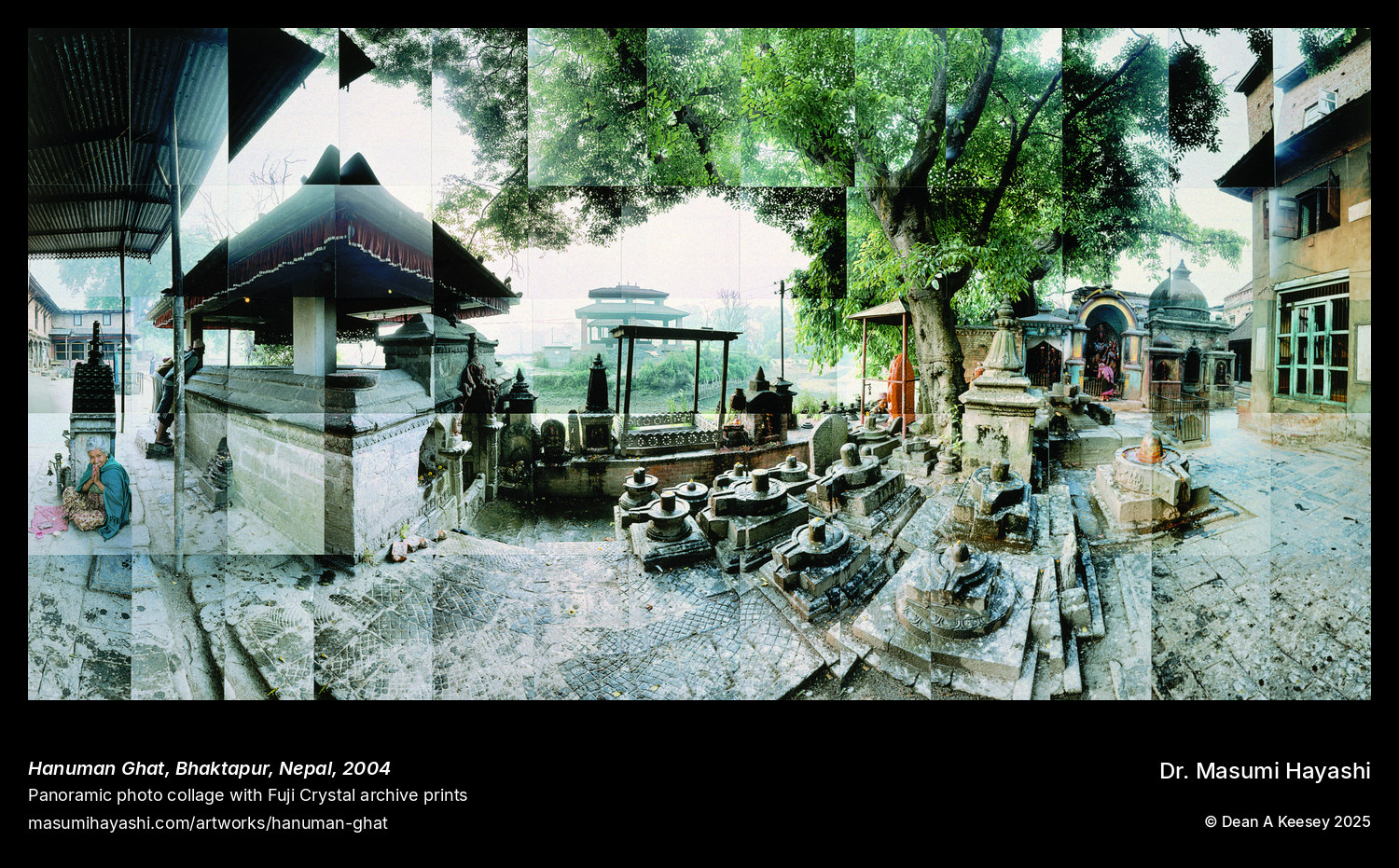
Hanuman Ghat, Bhaktapur, Nepal
Bhaktapur, Nepal
Panoramic Photo Collage
2004
24" x 45"
South Asian sacred architecture includes a typology foreign to most religious traditions: the ghat, monumental stone staircases descending from urban fabric to river water, creating liminal zones between terrestrial realm and sacred flow. At Hanuman Ghat in Bhaktapur, stepped terraces cascade from street level down multiple stone levels to the Hanumante River’s edge, facilitating ritual bathing, cremation ceremonies, access to water Hindu communities understand as purifying medium capable of cleansing sins, enabling spiritual merit, marking religious observances through physical immersion. The 24-by-45-inch vertical format—nearly four feet tall—documents the inherent vertical sequence that defines ghat architecture: the descent through space that mirrors spiritual descent toward purification, the top-to-bottom viewing experience replicating pilgrims’ physical movement down stone steps toward water.
The name honors Hanuman, the monkey deity from the Ramayana whose devotion to Rama epitomizes selfless service. A temple or shrine dedicated to Hanuman likely stands at these sacred steps, marking the site as place where divine devotion and human need for purification intersect. Pilgrims descend seeking cleansing—bathing in holy waters believed to wash away accumulated spiritual pollution, enable merit accumulation, facilitate religious observances requiring immersion. Some ghats also serve as cremation grounds where wooden pyres consume bodies, ashes scattered in flowing water enabling the deceased’s journey toward moksha, liberation from the cycle of rebirth. The ghat architecture accommodates both living purification and death rites, recognizing water as medium facilitating transitions between states: pollution to purity, life to death, samsara to liberation.
The vertical format challenges Hayashi’s predominantly horizontal panoramic practice. Where most Sacred Architectures works employ horizontal compositions documenting temple complexes’ lateral extent, this 45-inch-tall vertical captures descent impossible to convey horizontally. The format mirrors experience: standing at street level looking down stepped terraces toward river below, comprehending vertical distance through architectural cascade, understanding how ghat design organizes space to facilitate movement from urban realm toward sacred water. Horizontal composition would misrepresent this essential verticality, would fail to document how stone levels stack to bridge elevation change from city to river.
Created in 2004 alongside the Golden Temple during the same Kathmandu Valley photographic journey, this work expands documented architectural typologies from enclosed Buddhist courtyards and grand Hindu temple complexes to include riverine sacred landscapes. Bhaktapur maintains the most preserved medieval character among Kathmandu Valley’s historic cities, where traditional Newari urban fabric survives and active ritual practices continue within historic architectural settings. The ghats remain functional infrastructure, not museum pieces—pilgrims still descend for bathing, cremations still occur on riverside pyres, water access still serves daily and ritual needs, the stones worn smooth by centuries of feet making the same descent toward purification.
Eleven years after Hayashi’s photograph, the 2015 Gorkha earthquake devastated Nepal, damaging Bhaktapur’s heritage sites along with thousands of historic structures across the valley. This image potentially documents pre-earthquake ghat architecture subsequently altered through damage or reconstruction, establishing archival value beyond artistic achievement. When earthquakes strike masonry structures built before modern seismic engineering, terraced stonework can fail catastrophically—steps collapsing, retaining walls cracking, the careful vertical sequence disrupted through ground motion that doesn’t respect centuries of accumulated craftsmanship. Photography becomes evidence of what existed, what reconstruction should aim to restore, what engineering modifications might prevent future collapse while maintaining the ghat’s essential function: facilitating descent from profane urban space toward sacred river water where purification remains possible despite every historical disruption, where the Hanumante still flows and Hanuman still watches over those seeking cleansing at his dedicated steps.