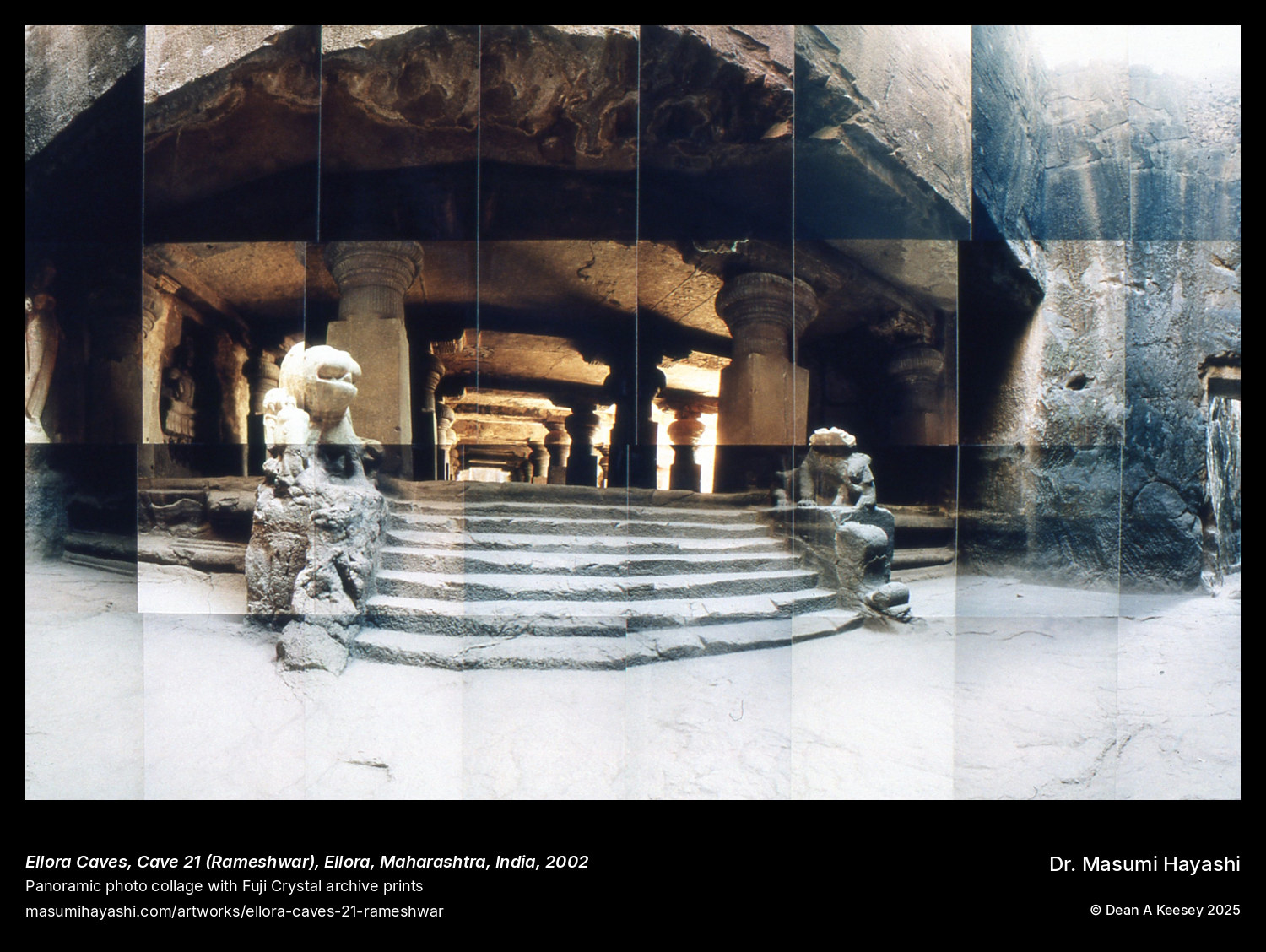
Ellora Caves, Cave 21 (Rameshwar)
Ellora, Maharashtra, India
Panoramic photo collage with Fuji Crystal archive prints
2002
45 x 29.5
This vertical 45-by-29.5-inch panorama documents Cave 21 at Ellora—the Rameshwar cave, a Hindu excavation dedicated to Shiva within the UNESCO World Heritage Site’s extraordinary concentration of rock-cut temples. The nearly four-foot height captures the cave’s multi-level architecture carved entirely from basalt cliff, the vertical format suited to documenting sculptural programs distributed across cave walls rising from floor to ceiling.
Created in 2002, the work complements Hayashi’s documentation of Cave 32 (Indra Sabha), establishing Ellora’s range across India’s three major religious traditions. While Cave 32 represents Jain monasticism, Cave 21 embodies Hindu devotion—specifically Shaivite worship centered on Shiva, the destroyer and regenerator among Hinduism’s primary deities.
The Rameshwar cave dates to approximately 600-650 CE, among the earliest Hindu excavations at Ellora when regional dynasties began patronizing cave temple construction on scales previously associated with Buddhist practice. The cave’s sculptural programs depict Shiva mythology: the god dancing as Nataraja, destroying demons, appearing with consort Parvati, and manifesting in the linga (aniconic cylindrical form) housed within the inner sanctum.
Rock-cut architecture represents extraordinary commitment of resources and labor—workers excavated from cliff face inward and downward, removing stone to reveal architectural forms rather than assembling structures from separate elements. Every column, beam, and sculptural detail was carved from original rock, errors irreversible without starting anew. This subtractive process reversed conventional construction logic, requiring visualization of complete design before removing first stone.
The vertical format captures the cave’s spatial organization: entrance portico opening to columned hall, sculptures arranged across wall surfaces, inner sanctum housing the Shiva linga at cave’s deepest point. Worshipers moving through the space experienced graduated darkness and increasing sanctity, the architectural progression replicating spiritual journey from worldly exterior toward divine presence within.