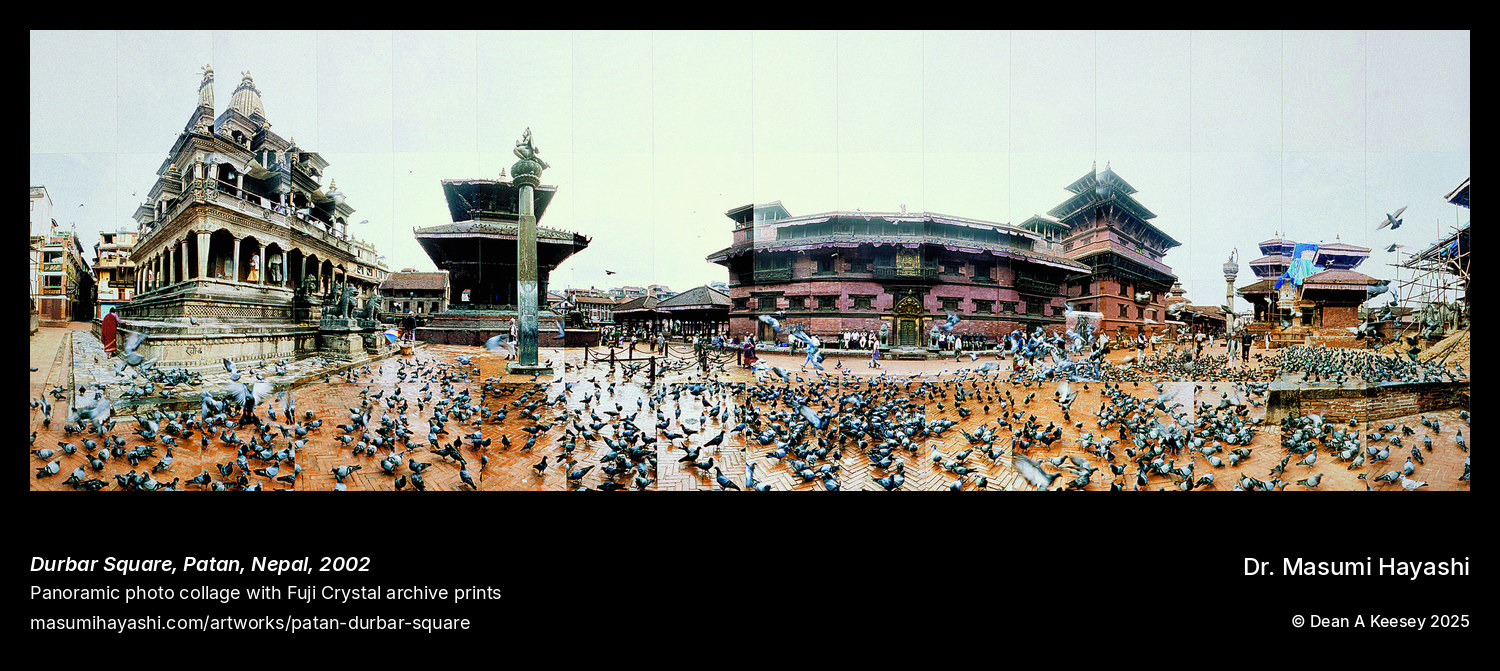
Durbar Square
Patan, n/a, Nepal
Panoramic photo collage with Fuji Crystal archive prints
2002
19.5 x 58.5
This horizontal 19.5-by-58.5-inch panorama documents Durbar Square in Patan—the ancient royal palace plaza representing the finest concentration of Newari architecture in the Kathmandu Valley. The nearly five-foot width captures the square’s architectural ensemble: royal palace facades, Hindu temples, Buddhist monasteries, and civic buildings arranged around open space where commerce, ceremony, and daily life have intersected for centuries.
Created in 2002, the work documents Patan (historically Lalitpur, “City of Beauty”) at a moment before the devastating 2015 Gorkha earthquake that damaged or destroyed many structures visible in the panorama. This pre-earthquake documentation acquires archival significance beyond artistic achievement—visual record of architectural heritage subsequently altered through catastrophic damage and reconstruction efforts.
Durbar Square represents Newari civilization’s architectural achievement—the indigenous culture of the Kathmandu Valley developing distinctive architectural vocabulary across centuries of Hindu and Buddhist synthesis. The square’s buildings demonstrate Newari characteristics: multi-tiered pagoda roofs with elaborate carved wooden struts, brick construction with decorative brickwork patterns, metal finials and ornamental details, and spatial organization balancing royal presence with religious devotion.
The Malla kings who ruled Kathmandu Valley’s three kingdoms (Kathmandu, Patan, Bhaktapur) between the fifteenth and eighteenth centuries competed through architectural patronage, each durbar square attempting to surpass rivals in temple construction and palace elaboration. Patan’s square represents this competitive excellence—the royal palace’s Krishna Mandir, the elaborate Taleju Temple, and numerous smaller shrines creating architectural density rivaling any medieval European plaza.
Unlike single-monument documentation elsewhere in the Sacred Architectures series, Durbar Square panoramas capture urban sacred architecture—the entire ensemble of structures, the spatial relationships between buildings, the plaza functioning as civic and religious center simultaneously. The horizontal format suits this documentation, the lateral sweep encompassing architectural variety impossible to convey through isolated monument studies.