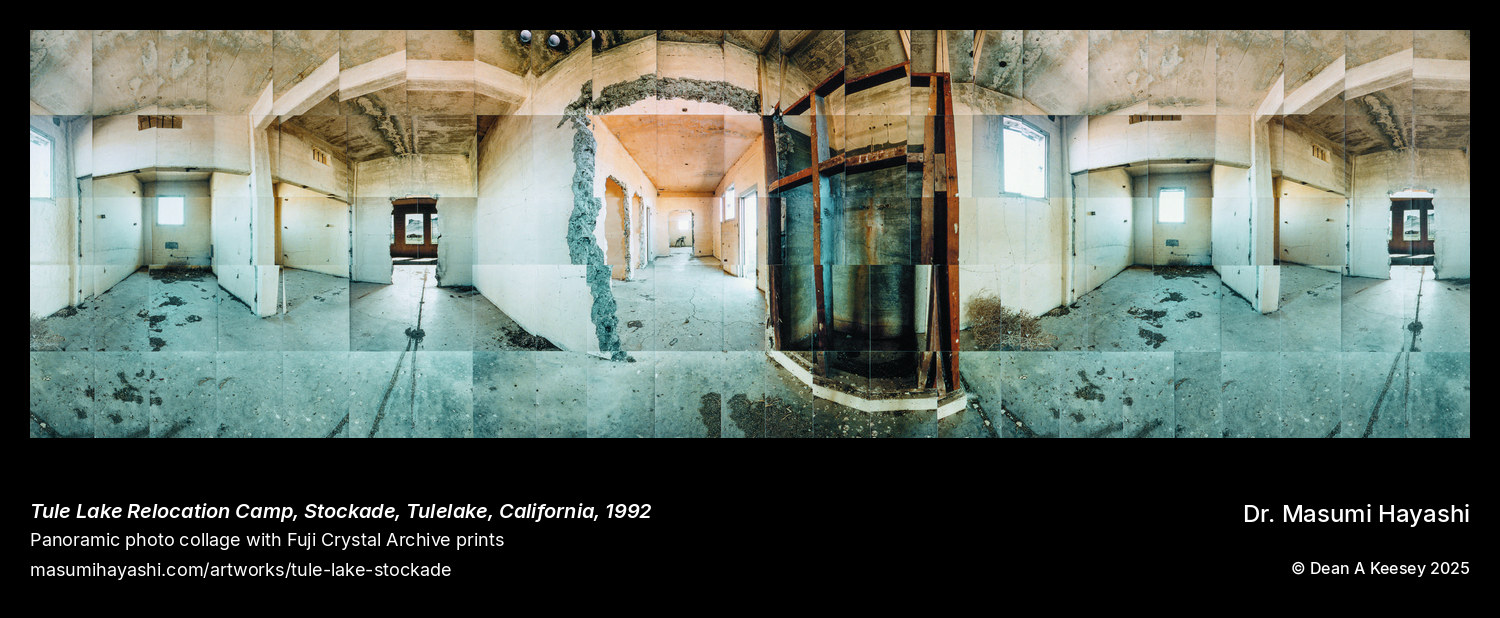
Tule Lake Relocation Camp, Stockade
Tule Lake, CA, USA
Panoramic photo collage with Fuji Crystal Archive prints
1992
27 x 79
This monumental 27-by-79-inch horizontal panorama documents the stockade at Tule Lake Relocation Center—the prison-within-a-prison where Japanese Americans deemed “troublemakers” were confined under military guard following the camp’s 1943 transformation into a segregation center. The nearly seven-foot width captures the stockade’s forbidding perimeter, the architectural vocabulary of maximum security applied to citizens whose only crime was asserting constitutional rights.
Created in 1992, this early documentation captures incarceration’s most extreme expression within the War Relocation Authority system. Tule Lake’s stockade confined those who organized protests, refused work assignments, or challenged camp administration—American citizens punished for resisting unconstitutional imprisonment through methods legal for any other citizen.
The stockade represented militarization of incarceration: following a November 1943 incident, the Army assumed control of Tule Lake, imposing martial law and constructing the stockade to isolate “agitators.” Conditions within the stockade were deliberately harsh: limited food, no heat despite winter cold, beatings by guards, indefinite confinement without due process.
The horizontal format captures the stockade’s forbidding extent—perimeter fencing, guard towers, the architectural apparatus of maximum security confinement. The nearly seven-foot width emphasizes the institutional scale of punishment directed at citizens whose only offense was refusing acquiescence to their own imprisonment.
The stockade’s survival—while mess halls and barracks have vanished—creates darkly ironic memorial: the structure designed for harshest punishment outlasting architecture intended for general population, the architecture of repression proving more durable than the architecture of confinement.
Tule Lake received National Monument designation in 2008, the federal government acknowledging that sites documenting constitutional violation warrant preservation for historical education.