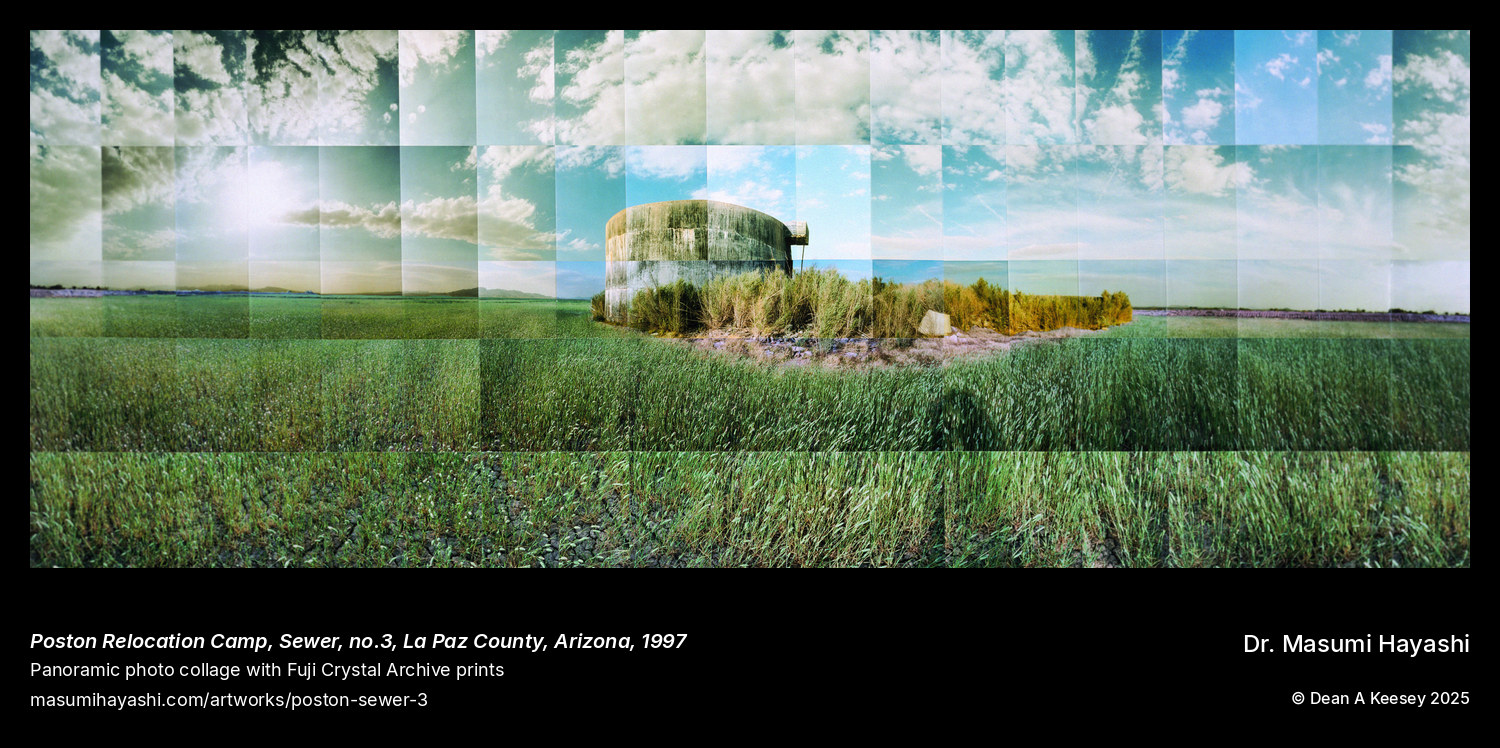
Poston Relocation Camp, Sewer, no.3
La Paz County, AZ, USA
Panoramic photo collage with Fuji Crystal Archive prints
1997
26 x 63
This horizontal 26-by-63-inch panorama documents sewer infrastructure at Poston Relocation Center—the third of three works systematically covering the largest War Relocation Authority camp where 18,000 Japanese Americans were imprisoned in Arizona’s Sonoran Desert. The over-five-foot width continues Hayashi’s comprehensive documentation of the sprawling complex whose three separate camps constituted Arizona’s third-largest city.
Created in 1997, the work represents the “No. 3” perspective on Poston’s sewer infrastructure, complementing works numbered 1 and 3 (with No. 2 either undocumented or unnumbered). This systematic approach recognizes that Poston’s extraordinary scale—three distinct camps stretching along the Colorado River—required multiple perspectives to convey the engineering achievement that enabled mass incarceration.
The sewer systems’ survival while human-occupied structures disappeared creates ironic memorial: infrastructure for processing waste outlasting architecture for housing people. The engineering that made Poston habitable—water supply, sewage treatment, electrical generation—represented enormous federal investment in constructing functional prison cities, the administrative competence serving unconstitutional purpose.
Poston’s location on Colorado River Indian Reservation land resulted from bureaucratic cynicism: the Bureau of Indian Affairs arranged the site intending to use internee labor developing irrigation infrastructure, extracting productive work from imprisoned citizens to benefit land from which Native Americans had themselves been dispossessed. Two histories of federal injustice intersected in the same desert.
The horizontal format captures the sewer system’s sprawling extent—collection lines, treatment facilities, and disposal infrastructure spreading across miles of desert landscape. The “No. 3” designation acknowledges that comprehensive documentation required returning to the same subject from different perspectives, the systematic approach serving historical record.