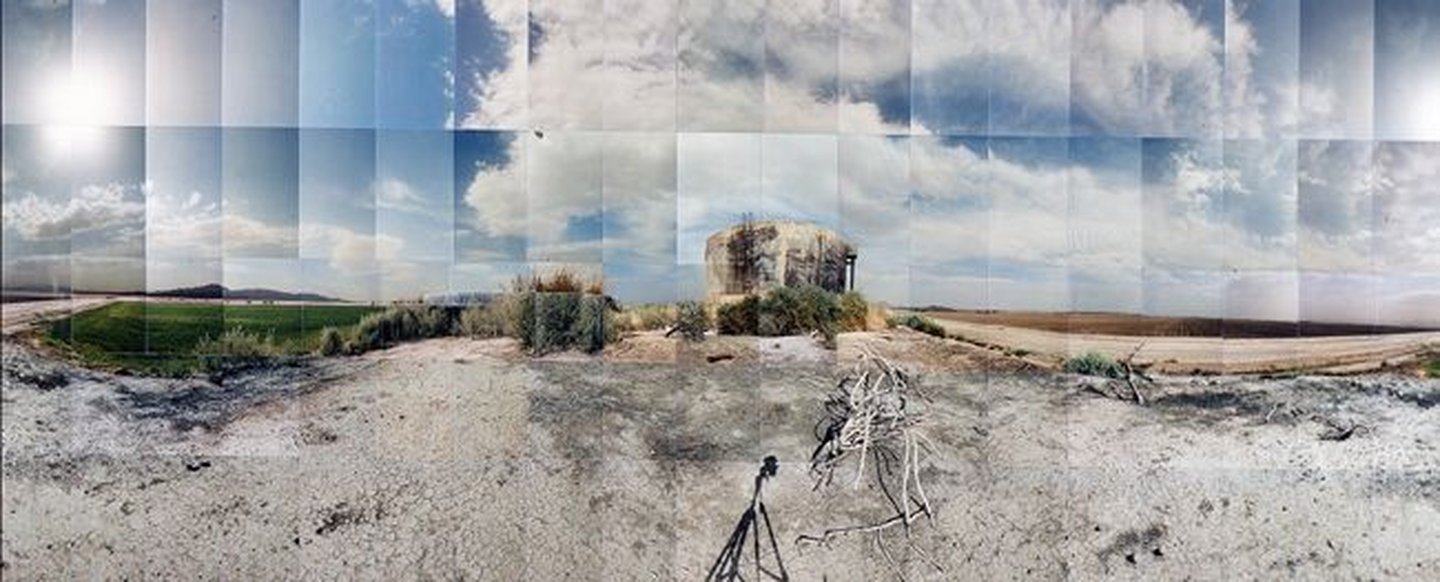
Poston Relocation Camp, Sewer, no.1
La Paz County, AZ, USA
Panoramic photo collage with Fuji Crystal Archive prints
1997
25 x 67
This horizontal 25-by-67-inch panorama documents the sewer infrastructure at Poston Relocation Center—the largest of the ten War Relocation Authority camps where 18,000 Japanese Americans were imprisoned on Colorado River Indian Reservation land in Arizona’s Sonoran Desert. The over-five-foot width captures the utilitarian engineering that made mass incarceration physically possible: sewage treatment systems designed for a population the size of a small city.
Created in 1997, the work continues Hayashi’s documentation of infrastructure remnants—the unsexy engineering that enabled incarceration but, paradoxically, outlasted the barracks and guard towers specifically designed for human confinement. The “No. 1” designation signals systematic coverage recognizing that Poston’s scale required multiple perspectives.
Poston’s three separate camps (known as Poston I, II, and III) together constituted Arizona’s third-largest city during operation, the population drawn primarily from Los Angeles and the Imperial Valley. The location on tribal land resulted from a cynical bargain: the Bureau of Indian Affairs planned to use internee labor to develop irrigation infrastructure, extracting productive work from incarcerated people to benefit a land base from which Native Americans themselves had been dispossessed.
The sewer systems document the speed and efficiency of mass incarceration’s implementation—within months, the War Relocation Authority constructed complete urban infrastructure in remote desert locations: water supply, sewage treatment, electrical generation, roads, and buildings for thousands. This administrative competence, directed toward unconstitutional purpose, demonstrates how bureaucratic efficiency can serve injustice.
The horizontal format captures the sewer system’s sprawling geography—collection lines, treatment facilities, and disposal infrastructure spreading across desert landscape. The engineering’s mundane functionality contrasts with the trauma its purpose enabled, the sewage treatment serving as metonym for incarceration’s dehumanizing systematization.