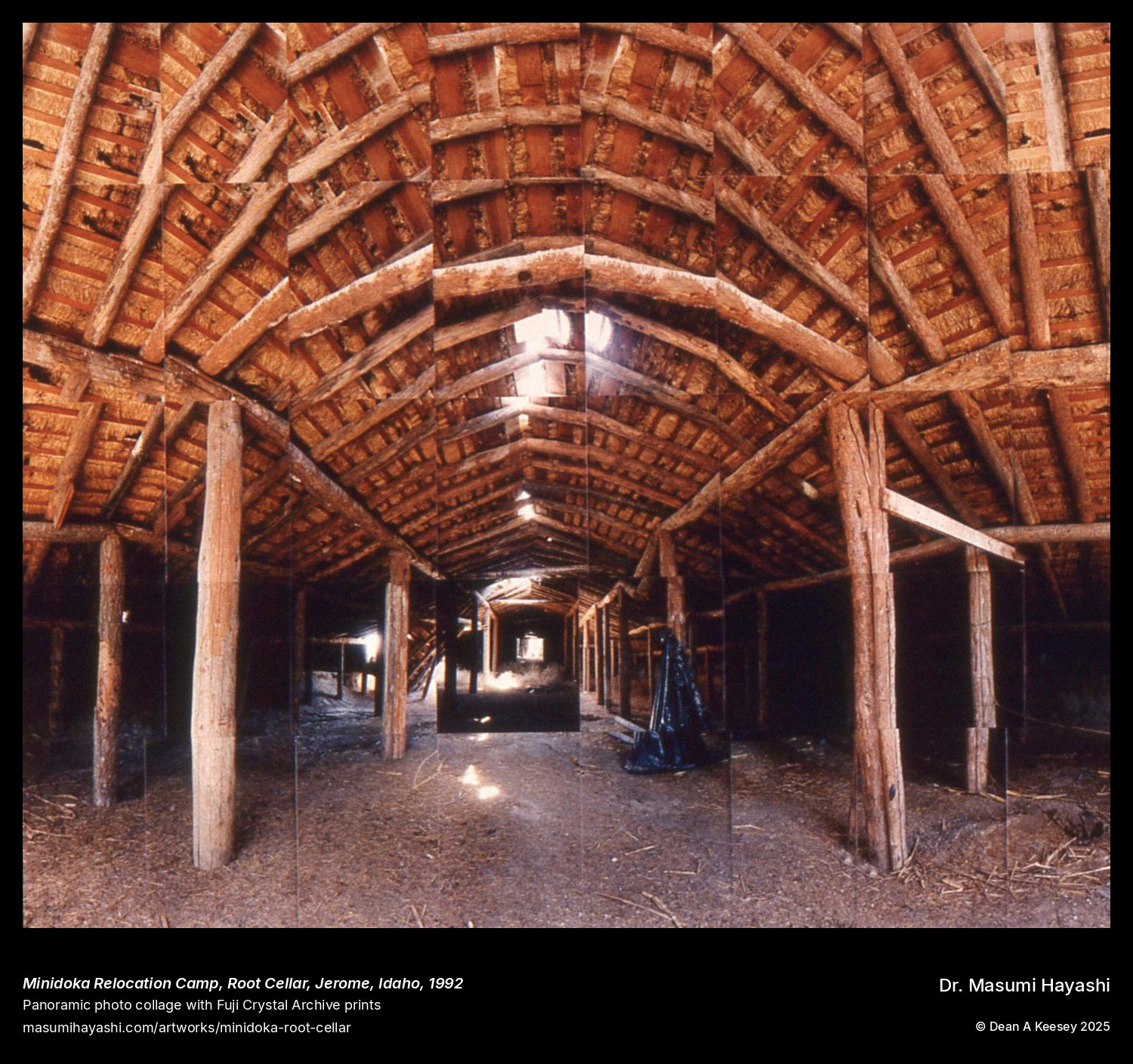
Minidoka Relocation Camp, Root Cellar
Jerome, ID, USA
Panoramic photo collage with Fuji Crystal Archive prints
1992
28 x 32
This 28-by-32-inch near-square panorama documents a root cellar at Minidoka Relocation Center—underground storage that internees constructed to preserve vegetables through Idaho’s harsh winters. The compact format suits intimate documentation of semi-subterranean architecture whose small scale contrasts with the institutional structures characterizing most camp documentation.
Created in 1992 alongside the Visitors Waiting Room, this represents one of Hayashi’s earliest camp documentations. Root cellars embody internee agency within constraint—self-built structures supplementing inadequate government provisions, the agricultural knowledge that Japanese American farmers brought to incarceration enabling survival beyond official rations.
The root cellar’s persistence while barracks vanished reflects construction quality: internees built for durability, their investment in underground storage demonstrating expectation of prolonged confinement despite official claims of temporary emergency. The earth-insulated structure outlasted the tar-paper barracks that government contracts specified for minimal cost.
Minidoka’s agricultural context made root cellars practical: the camp occupied former desert that internees transformed through irrigation into productive farmland. Japanese American farmers—many forcibly removed from California’s richest agricultural regions—applied expertise to hostile soil, growing vegetables that supplemented inadequate mess hall provisions while demonstrating capabilities the government’s racist assumptions denied.
The near-square format emphasizes the root cellar’s intimate scale: a structure sized for family food storage rather than institutional operation. The compact dimensions contrast with the vast horizontal panoramas capturing camp landscapes, documenting domestic survival at human scale.
The root cellar’s survival documents internee initiative: people imprisoned for ancestry nonetheless building infrastructure for prolonged residence, their construction skills creating structures that outlived the camp’s official architecture. The work represents agricultural tradition persisting through incarceration.