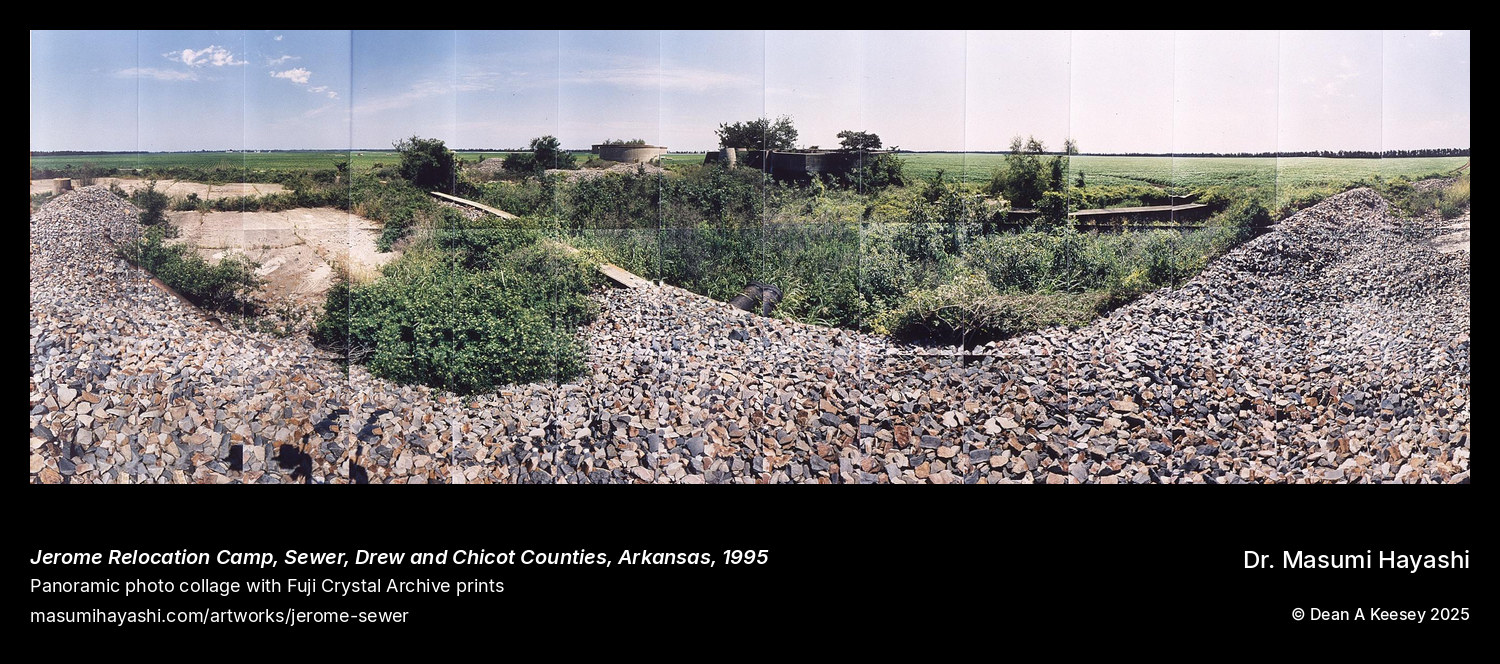
Jerome Relocation Camp, Sewer
Drew and Chicot Counties, AR, USA
Panoramic photo collage with Fuji Crystal Archive prints
1995
23 x 50
This horizontal 23-by-50-inch panorama documents the sewer infrastructure at Jerome Relocation Center—the Arkansas camp where 8,500 Japanese Americans were imprisoned in the Mississippi Delta’s swampland from 1942 to 1944. The four-foot-plus width captures utilitarian engineering that made mass incarceration possible in one of the system’s most challenging environments.
Created in 1995, the work continues Hayashi’s documentation of surviving infrastructure across the War Relocation Authority system. Jerome’s sewer system enabled incarceration in conditions fundamentally unsuited for human habitation: swampland requiring drainage, humidity fostering disease, flooding threatening structures, and heat creating misery for internees accustomed to California’s temperate coast.
Jerome was the last camp to open and the first to close—its brief 1942-1944 operation reflecting difficulties operating incarceration in the Mississippi Delta’s hostile environment. The camp’s population was transferred to other sites as the War Relocation Authority consolidated operations, the administrative machinery of incarceration demonstrating efficiency even in managing the imprisoned population.
The sewer system’s survival while human-occupied structures vanished creates ironic memorial: the mechanism for processing human waste outlasting the barracks that housed the human beings. The engineering that made Jerome minimally habitable—drainage, sewage treatment, water supply—represented federal investment in constructing functional prison in profoundly unsuitable location.
Jerome’s location subjected internees to conditions vastly different from their California homes: subtropical humidity, mosquitoes carrying malaria, venomous snakes, and flooding that regularly inundated the low-lying site. The sewer system documents the engineering required to operate incarceration in such challenging environment.
The horizontal format captures the sewer infrastructure’s extent across the swampy landscape, the engineering achievement serving unconstitutional purpose in one of the incarceration system’s most difficult sites.