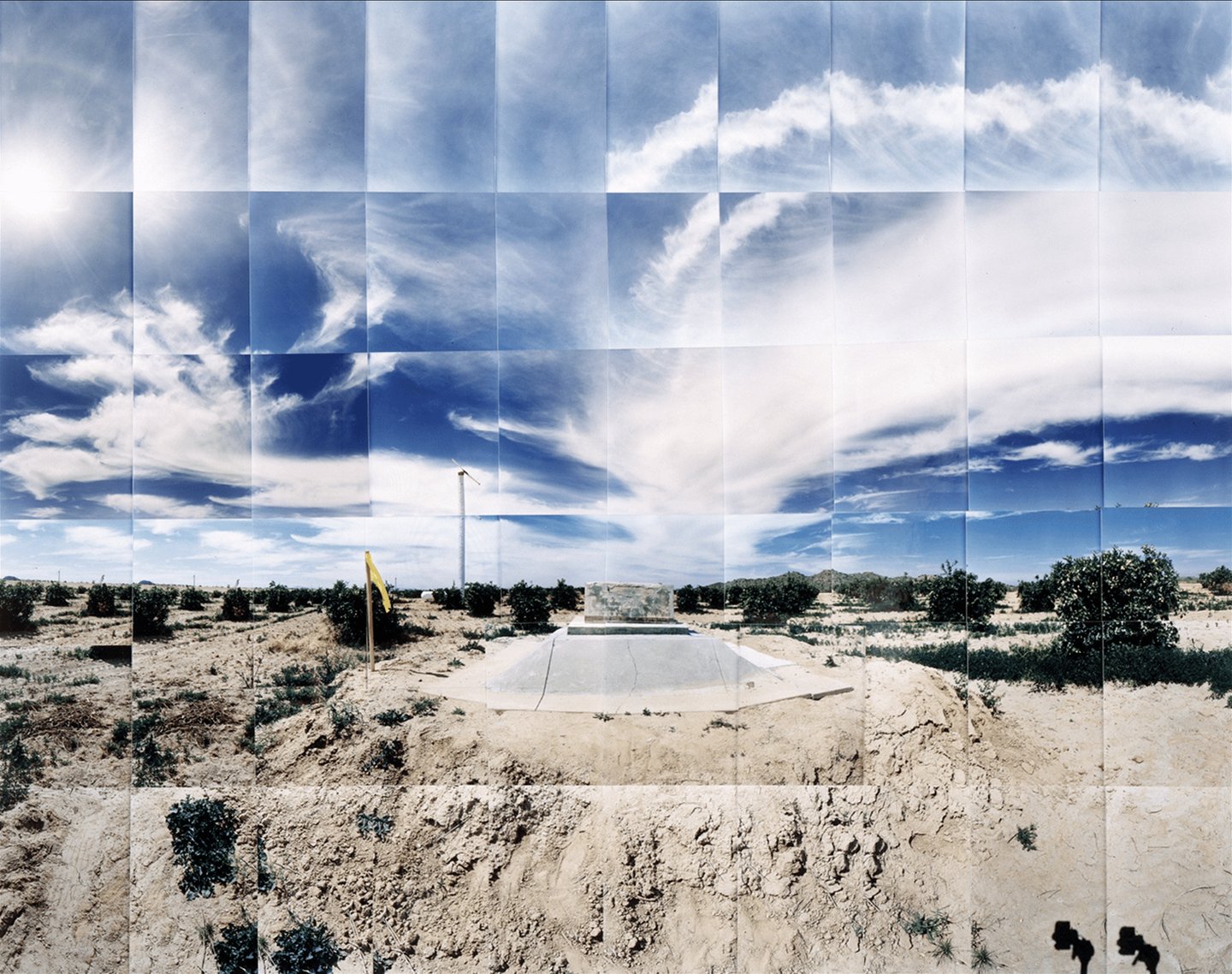
Gila River Relocation Camp, Dog Grave
Gila River, AZ, USA
Panoramic photo collage with Fuji Crystal Archive prints
1995
38 x 31
This 38-by-31-inch near-square panorama documents a dog’s grave at Gila River Relocation Center—an intimate memorial marking where a family pet was buried within the Arizona camp that imprisoned 13,348 Japanese Americans from 1942 to 1945. The compact format suits documentation of this small marker, the concentrated composition emphasizing personal loss within mass incarceration’s industrial scale.
Created in 1995, the work represents Hayashi’s most intimate engagement with the human dimension of camp experience. While other works document infrastructure, foundations, and institutional architecture, the dog grave acknowledges that families brought beloved animals to incarceration—pets whose deaths during imprisonment created grief compounded by circumstances that made mourning itself constrained.
The grave marker’s survival across decades represents community determination to maintain even small memorials. Internees constructed this marker for a pet, their care for the animal’s resting place demonstrating the persistence of normalcy amid profound abnormality. The grave’s location within camp boundaries meant the family could not later move their pet’s remains—the animal permanently interred where constitutional rights were suspended.
The near-square format contrasts with the vast horizontal panoramas characterizing most camp documentation. Where other works emphasize incarceration’s geographic scale—hundreds of acres, thousands of buildings—this intimate composition focuses on a single small marker. The shift in scale acknowledges that mass incarceration’s trauma operated at both systemic and personal levels.
Dogs and other pets accompanied families to camps, their presence providing emotional support during displacement and confinement. The pets that died during incarceration left small graves scattered across camp landscapes—individual losses within collective trauma, the death of a family companion adding grief to already overwhelming circumstances.
The work documents the intersection of personal and political: a family’s beloved pet buried in Arizona desert because American racism demanded imprisonment based solely on ancestry.