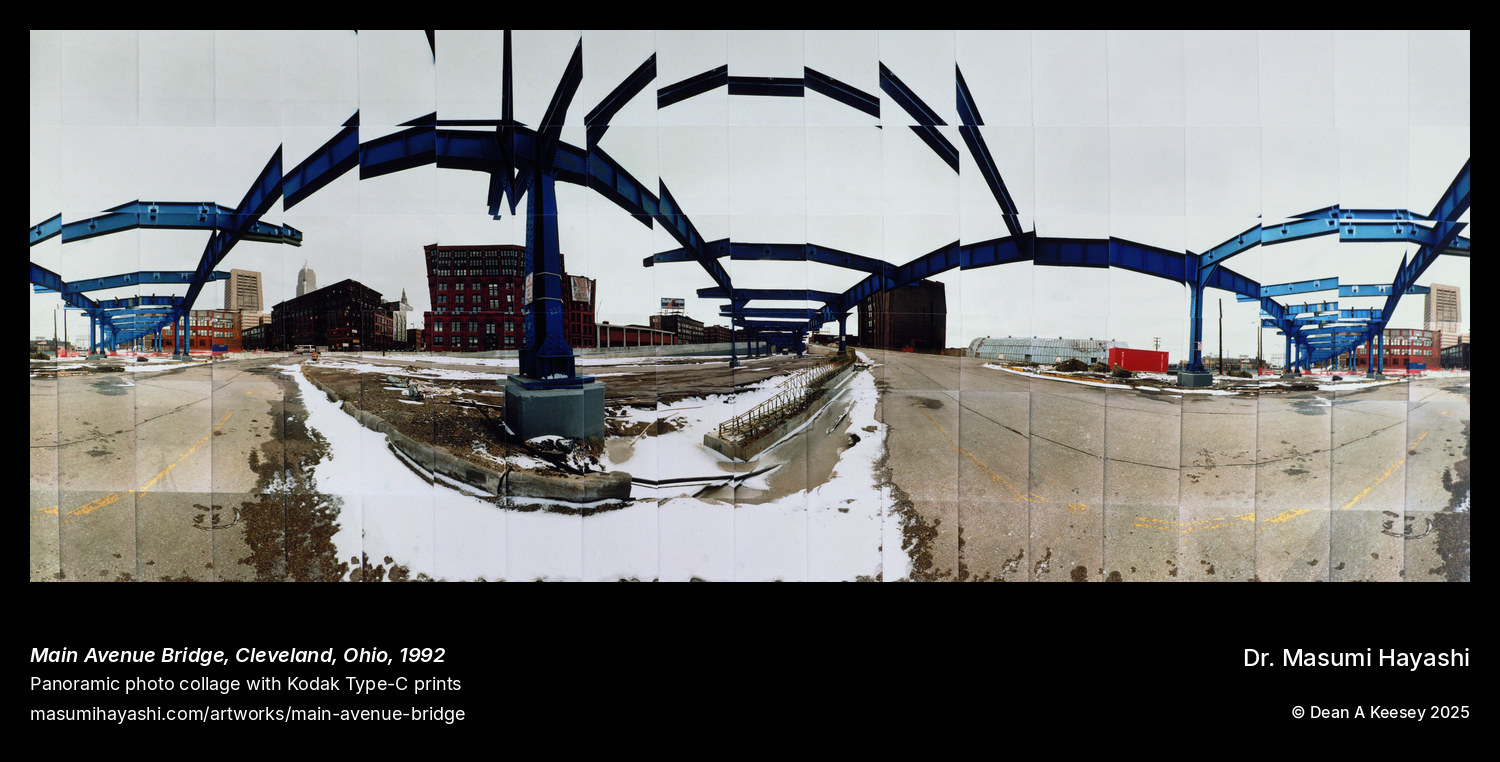
Main Avenue Bridge, Cleveland, Ohio
Cleveland, OH, USA
Panoramic Photo Collage
1992
26 x 66
Cleveland is a city divided by a river. The Cuyahoga cuts through its center, carving a deep valley that separates eastside from westside—neighborhoods that developed distinct identities in part because crossing between them required bridges. The bridges became infrastructure of unity, the physical means by which a topographically divided city held itself together.
Main Avenue Bridge is one of the less celebrated spans in Cleveland’s bridge network. It lacks the Art Deco monumentality of Hope Memorial or the grandeur of the Detroit-Superior viaduct. It’s a working bridge, a steel truss structure that moves people and vehicles across the valley without announcing itself as architecture. The kind of infrastructure that functions precisely because no one thinks about it.
Masumi photographed it overlooking the Flats—Cleveland’s industrial riverfront where steel mills, ore docks, and manufacturing plants once defined the city’s economy. By 1992, many of those facilities were closing or already gone. The bridge carried less traffic to fewer jobs. Yet the structure remained, connecting neighborhoods whose reasons for being connected had shifted beneath them.
Her photo collage technique fragments and reassembles the bridge’s steel geometry—truss patterns, framework, the relationship between deck and supports—creating a panorama that captures the structure’s functional elegance. Not architecture meant to impress, but engineering meant to work. The photograph treats this utilitarian infrastructure as worthy of the same attention usually reserved for landmarks and monuments.