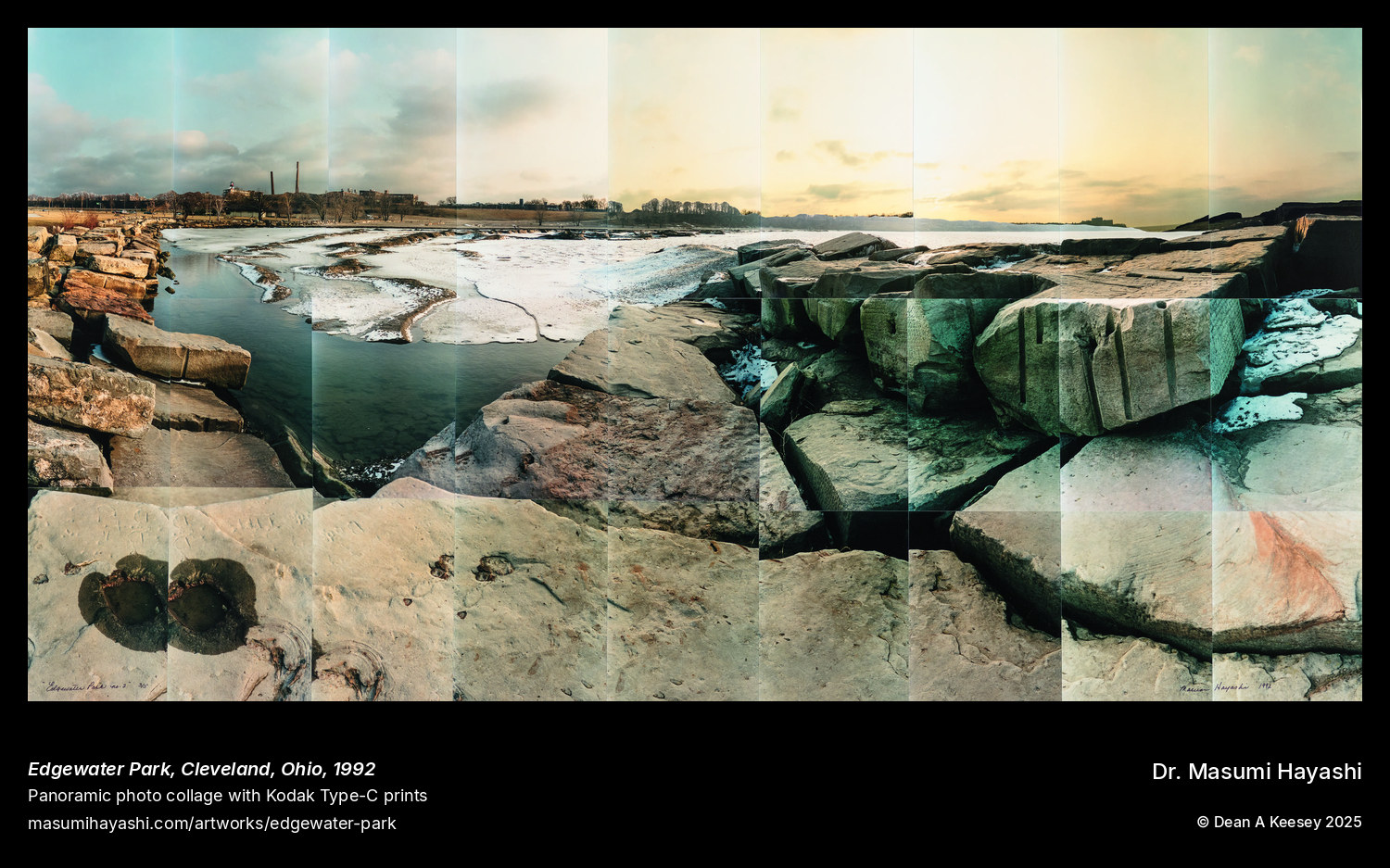
Edgewater Park
Cleveland, OH, USA
Panoramic Photo Collage
1992
38 x 67
For most of Cleveland’s industrial era, Lake Erie’s shoreline belonged to steel mills, ore docks, and power plants. Working-class neighborhoods on the westside could smell the lake, hear the lake, know the lake was there—but reaching it meant navigating through industrial zones that treated the waterfront as resource rather than amenity.
Edgewater Park was the exception. Established in 1894 and expanded over subsequent decades, it gave Ohio City and Tremont residents 255 acres of public beach, picnic groves, and fishing piers. Democratic access in a city where most waterfront was private or industrial. The park embodied progressive-era ideals: public recreation as civic right, not class privilege.
By 1992 when Masumi made this photograph, Edgewater occupied an uncertain position. Decades of deferred maintenance showed. Industrial pollution and sewer overflows had raised water quality concerns. Suburban recreation facilities drew families who might once have spent summers here. Yet the park remained—still offering the same democratic waterfront access that had defined it for a century, still connecting urban Cleveland to the vastness of Lake Erie.
Masumi used 8×10 large-format film for this work, a technical choice connecting to the classic landscape photography tradition of Ansel Adams and Edward Weston. The format captures the subtle gradations of water meeting sky, the atmospheric effects of Great Lakes light. Her photo collage technique assembles these large-format exposures into a panorama that conveys the scale of the lakefront—the way standing at Edgewater means standing at the edge of something immense, an inland sea stretching to horizons you cannot see.