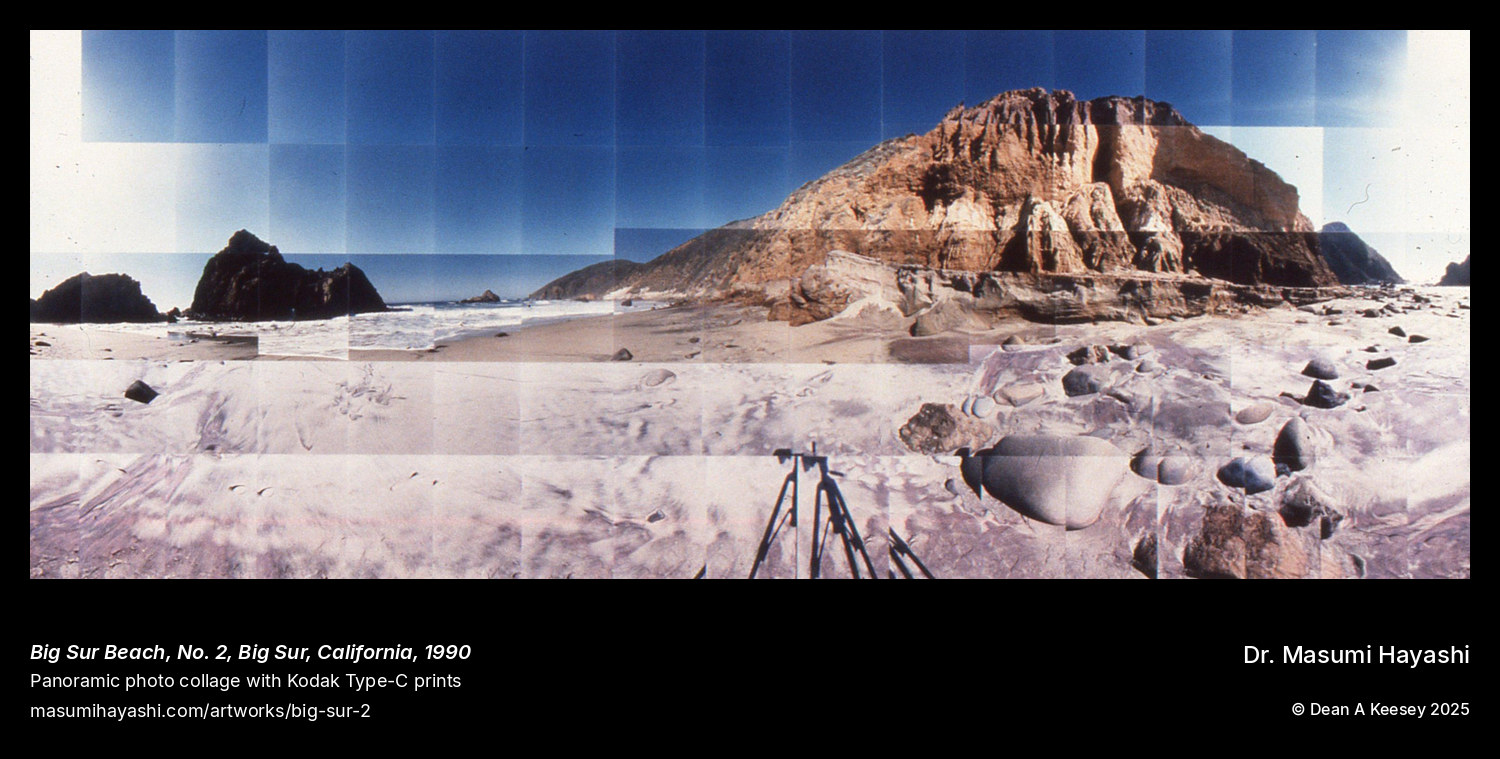
Big Sur Beach, No. 2, Big Sur, California
Big Sur, CA, USA
Panoramic Photo Collage
1990
22 x 56
Ninety miles of California coast where the Santa Lucia Mountains fall straight into the Pacific. No gradual slope, no beach towns, no development—just cliff and ocean and the thin ribbon of Highway 1 carved into the mountainside. Big Sur.
By 1990 when Masumi made this photograph, Big Sur had accumulated decades of American mythology. The highway opened in 1937, finally connecting this isolated stretch of coast to the rest of California. Henry Miller lived here through the 1940s and 50s, writing about it as a place where “the face of the earth is in travail.” The Beats followed. Then the counterculture. Then three million tourists a year, all seeking the wilderness that their presence threatened to erode.
Masumi’s photo collage captures this paradox. The technique fragments the coastline into dozens of individual photographs, then reassembles them into a panorama that feels both documentary and dreamlike. You see the beach as the eye actually experiences it—not the single frozen moment of conventional photography, but the accumulated glances of someone standing there, looking around, taking it in.
This is landscape as cultural artifact. Not just rocks and waves, but a place freighted with meaning: environmental protection, artistic pilgrimage, the California dream of unspoiled nature preserved at the edge of the continent. The photograph documents not just what Big Sur looks like, but what it means to a culture that has spent a century projecting its fantasies onto this particular stretch of coast.