Angel Island Immigration Station, Men’s Section
San Francisco Bay, CA, USA
Panoramic photo collage with Kodak Type-C prints
1989
22 x 84
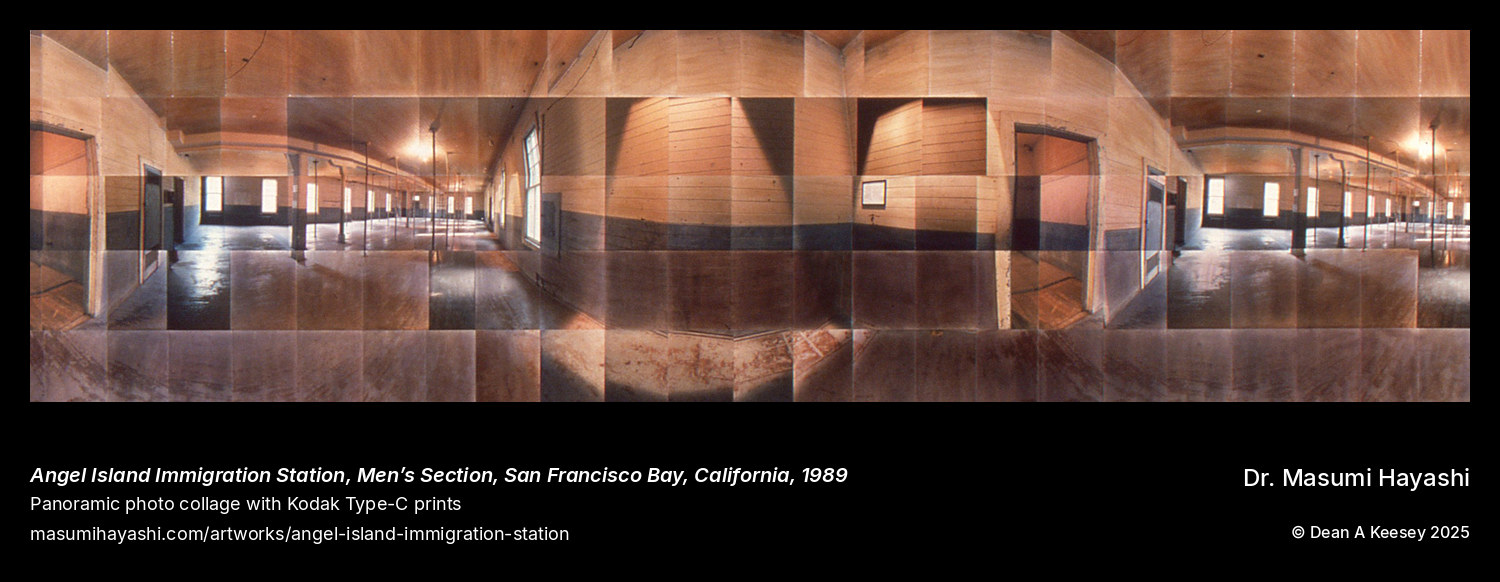
This 22-by-84-inch horizontal panorama documents the men’s section of Angel Island Immigration Station in San Francisco Bay—the facility that processed immigrants arriving on the Pacific coast and where Chinese immigrants were detained under the Chinese Exclusion Act from 1910 to 1940. The seven-foot width captures the detention barracks where thousands awaited decisions on their right to enter America.
Created in 1989, the work documents a site whose history parallels the Japanese American incarceration that Hayashi extensively documented elsewhere. Angel Island represented a different form of detention based on race: Chinese immigrants held for weeks or months while officials interrogated them under laws designed to exclude Chinese from American citizenship.
The horizontal format captures the barracks’ linear extent, the composition emphasizing the institutional architecture of detention. The photo collage technique fragments this immigration infrastructure while revealing spatial conditions that Chinese detainees experienced for periods ranging from weeks to years.
The walls of the Angel Island detention barracks preserve Chinese poetry carved or written by detainees—testimony to conditions that the exterior documentation cannot directly reveal but that the building’s history makes present. These poems, expressing loneliness, frustration, and determination, survived decades of obscurity before preservation efforts recognized their significance.
Angel Island became a California State Park in 1963 and the immigration station was designated a National Historic Landmark in 1997. This panorama documents the physical infrastructure of exclusionary immigration policy, connecting Asian American history across different communities and eras.
More from City Works
Big Sur Beach, No. 2, Big Sur, California
Case Western Reserve University, Lewis Building (Gehry)
Cleveland Stadium, Cleveland, Ohio
Cultural Gardens #2, Yugoslavian
Cultural Gardens #3, Hebrew